They gave her a straw hut so she could die there… But the sound beneath the floor changed everyone’s fate 😱💔
I was 53 years old when my own son threw me out of my home. Not a stranger.
My eldest son, Jacinto — the child I had fed from my own body, the boy I had stayed awake for through fevers, the one I had
begged God to spare even if it meant taking me instead.
He stood in the middle of our house in a clean shirt, with cold eyes, while his wife, Judith, smiled from the corner as if she
had been waiting for that day for years.
“Mother,” Jacinto said without blinking, “you have become a burden to us. There is an old hut at the end of the hill. You can
live there. At least you’ll have a roof over your head when you die.”
I did not cry after those words.
A person does not cry the moment their heart breaks. They simply go silent, because the pain is bigger than any sound.
The next morning, a cart came for me. My entire life fit inside two old trunks, my mother’s iron pot, and a worn blanket.
Forty-two years of marriage, three children, thousands of sacrifices… and in the end, three bundles.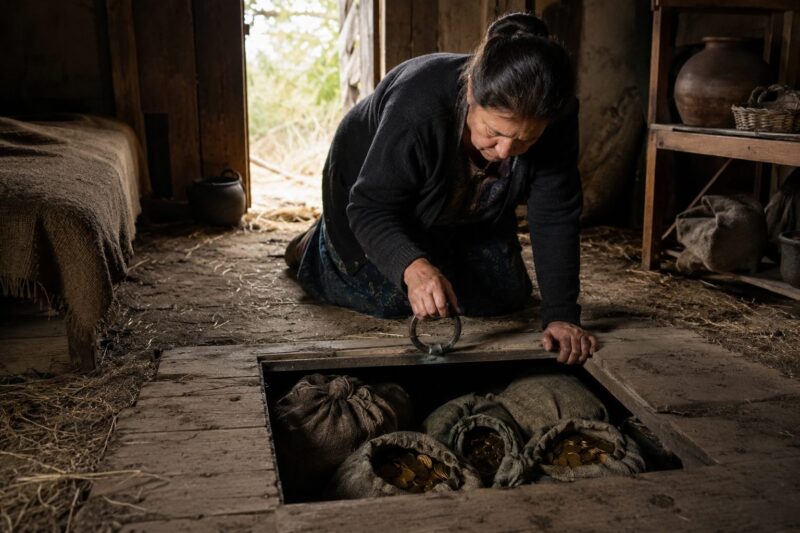
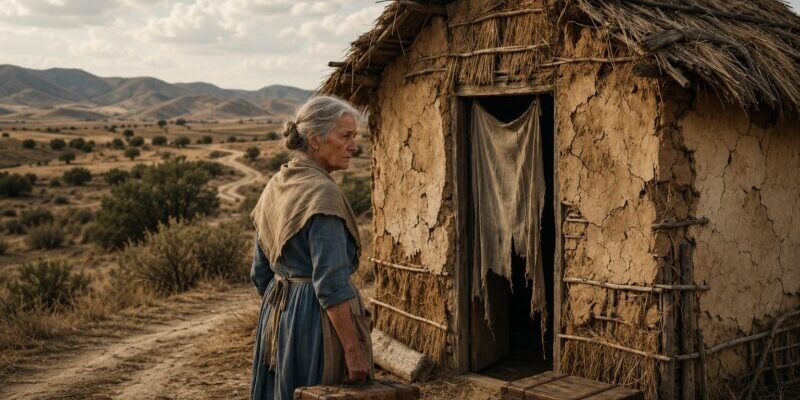
The hut stood at the far end of the hill, surrounded by thick bushes, stones, and loneliness. The walls were cracked, the roof
was full of holes, and instead of a door, an old rag swayed in the wind. When I stepped inside, the smell of mold nearly
choked me. The floor was uneven dirt, cobwebs filled the corners, and cold light slipped through the cracks in the walls.
That night, I lay on the floor and stared at the sky through a hole in the roof.
“God,” I whispered, “are You seeing this?”
There was no answer. Only the wind whistling through the cracks.
In the morning, just as I was beginning to believe I would die there exactly as my son wanted, something caught my eye.
Beneath a pile of old straw, in the darkest corner, something glimmered. I moved closer. It was an iron ring — thick, rusted,
fixed into the ground.
My heart began to beat uneasily. Why would there be an iron ring in the floor of an abandoned hut?
I knelt and pulled.
At first, nothing happened. Then I pulled with all my strength, and a dry cracking sound came from beneath the floor. A
board lifted. Dust filled the air. And underneath it, a dark hole opened.
I held my breath. Inside the hole were sacks. Old, heavy sacks tied with rope. My hands trembled as I pulled the first one out.
I untied the rope, and under the candlelight, gold shone back at me.
Gold coins. So many of them that, for a moment, I thought I was dreaming.
In the second sack were stones — red, green, clear stones that sparkled like fallen stars. I did not know their names, but I
knew one thing: I was looking at a fortune that could either save a person… or get them killed. Then I heard footsteps
outside. Slow. Human footsteps.
I blew out the candle and froze in the darkness. Someone was standing near the hut. I could not see them, but I could feel
them. I held my breath so long my chest began to ache. Then the footsteps moved away. That night, I understood the
treasure was not only my secret. Someone else knew about it.
The next day, I went down to the village and exchanged only one gold coin. Don Malaquías, the shopkeeper, narrowed his
eyes when he saw it.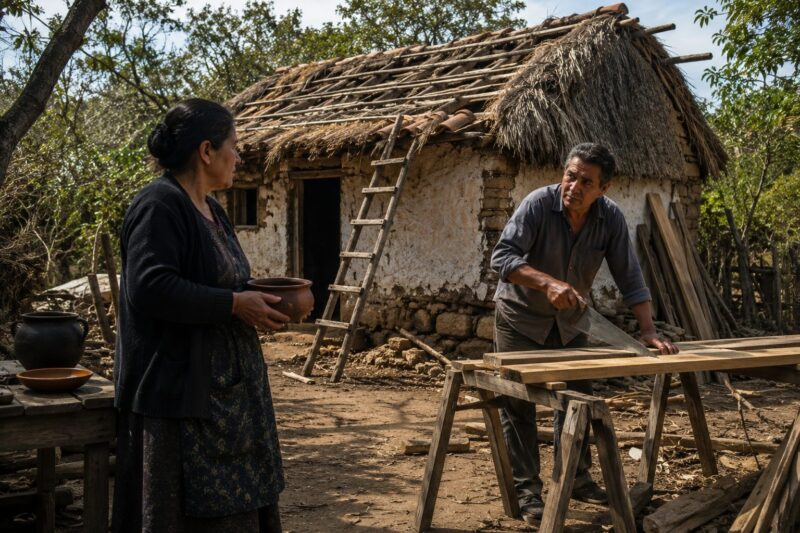
“A coin like this does not usually belong in the hands of an ordinary woman, Doña Teodora.”
I looked straight at him.
“Sometimes an ordinary woman hides more than ordinary things.”
He said nothing, but his eyes followed me all the way to the door.
With that money, I hired Lorenzo Bautista, a widowed carpenter. He came, looked at the hut, and said:
“This can be turned into a home.”
He worked quietly, honestly, without asking unnecessary questions. Day by day, the cracked walls grew stronger, the leaking
roof was replaced, wooden planks covered the dirt floor, and where the rag had once hung, a heavy wooden door appeared
with a lock on the inside. But the more beautiful the house became, the louder the village whispers grew.
“That woman suddenly has money.”
“That widowed carpenter keeps visiting her.”
“Maybe they are living in sin.”
I remained silent until the day Jacinto came. He arrived on horseback with two armed men. He looked at my repaired house,
and his face darkened.
“I sent you here to die, Mother,” he said, “not to become rich.” What happened next read in the comments 👇‼️👇‼️
After those words, I looked at him for the first time not as my son, but as a man who had already killed me in his heart.
“This house is mine,” I said. “You gave it to me.”
His eyes burned with rage.
“You have three days. That carpenter will not set foot here again. If he does, I will take you back and lock you away where you
will never see daylight.”
He left, but the fear stayed.
That night, I went to Lorenzo’s house and told him everything — about the ring, the hole, the gold, the stones, the footsteps, and my son’s threat.
He stayed silent for a long time, then said:
“If you keep this alone, they will kill you. If you trust someone, you may survive.”
Together, we moved part of the treasure to a cave hidden behind a waterfall. We left the rest carefully buried. On the third day, Jacinto returned, this time with more men.
But Lorenzo was standing in front of my door.
“This woman is not alone,” he said.
That day, my son did not dare touch me. But the village gossip grew so much that the priest himself came to us.
He looked at us and said:
“If he is protecting you, and you trust him, then marry. Let no one have the right to stain your names.”
I looked at Lorenzo. He did not beg. He did not pressure me. He only waited.
And I understood that, for the first time in my life, the choice was mine.
We married without celebration, without luxury, but with peaceful hearts.
We kept the treasure not for revenge, but for a new life. We bought land, built small homes, and welcomed the people whose families had forgotten them — widows, the elderly, abandoned women.
People began calling that place “Rebirth.”
And every evening, I sat on the porch of the house that had once been given to me so I could die, watching others learn how to live again.
Jacinto never apologized.
But I no longer needed him to.
Because sometimes, God does not save us from pain.
He turns pain into a door.
And my door opened on the very day my son sent me to a straw hut to die.