The teacher threw her secret papers on the floor in front of everyone… But one sentence from the 16-year-old girl made the
entire classroom freeze 😱💔😱💔
The first sheet of paper hit the floor like a verdict.
Then the whole stack slid off the desk and scattered across the gray tiles near Ava Carter’s shoes. No one in the classroom
spoke.
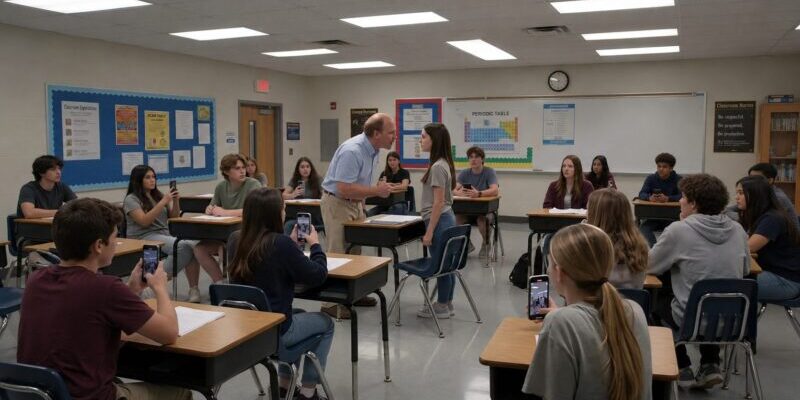
Thirty students sat in silence. Some stared at the floor. Some looked at the teacher’s red face. A few kept their phones hidden
on their laps, already sensing that this was no ordinary class anymore.
Mr. Dennis Harrow stood in front of Ava, his light blue shirt tight across his shoulders, his breathing heavy, his eyes filled with
the kind of anger that frightens people not because it is loud, but because it believes it has the right to do anything.
“Wait,” he snapped. “Are you trying to correct me?”
Ava did not sit down.
She was only sixteen. A girl in a gray T-shirt and jeans, with long brown hair, the kind of student who was supposed to get
scared, apologize, and lower her head. But she stayed standing beside her desk. Her face was pale. Her hands were shaking.
Yet her eyes remained fixed on his.
“No,” she said calmly. “I’m not sitting down.”
Somewhere behind her, a chair creaked.
Then silence returned. Those papers were not homework. They were not class notes.
They were documents Ava had hidden for three weeks inside her backpack, taped beneath the lining where no one would
think to look. Copies. Emails. Altered grade reports. And most important of all, the final written statement her mother had
left before she died.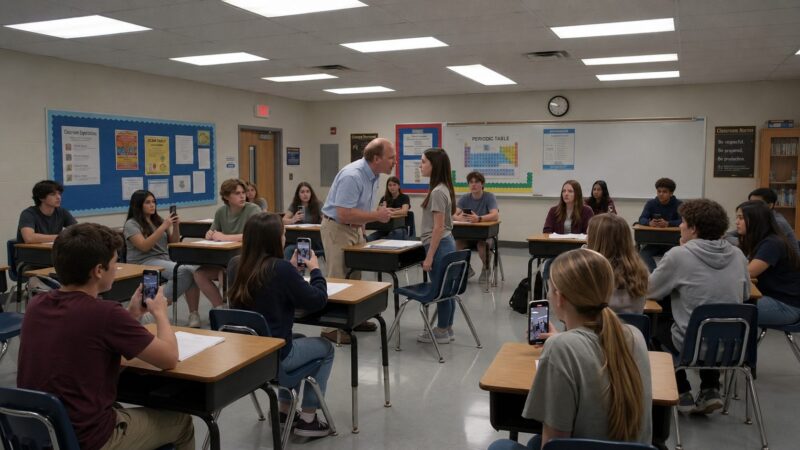
Her mother, Grace Carter, had taught English at that same school for fourteen years. Students loved her because she did not
see them as grades on a page. She saw them as people. But three months before her death, Grace discovered something.
Grades were being changed for children from wealthy families. Violations by student athletes were being erased. And
students from poor families who complained about unfair treatment were suddenly labeled as “problematic” and pushed
out of honors classes. Grace began collecting evidence. Then, one rainy evening, the brakes on her car failed.
The official report called it a mechanical failure. The school sent flowers. Principal Vale gave a moving speech. Mr. Harrow
even cried in front of the other teachers. Only Ava did not believe it.
Because two days before the accident, her mother had given her a flash drive and whispered, “If anything happens to me,
don’t give this to anyone at school.” At the time, Ava thought her mother was exaggerating.
Now she knew her mother had been afraid of the right people.
Mr. Harrow had noticed the folder that morning. That was why he had watched Ava the entire class period. And when she
corrected the sentence he had written on the board during civics class — “Authority exists to be obeyed” — everything
exploded.
“Authority has limits,” Ava had said. “It cannot be used to silence people.”
After that, the teacher came to her desk, saw his own staff ID on the top page, the emails, the principal’s name, her mother’s
statement… and lost control. He grabbed the papers and threw them onto the floor.
“You have no idea who you’re talking to,” he said through clenched teeth.
Ava looked down at the scattered pages. For one moment, something inside her broke. Her mother’s handwritten words
were lying on the classroom floor near the students’ shoes like trash.
But then she saw one page beside Mr. Harrow’s shoe. At the top was the name of the state investigator: Mara Ellis.
Ava lifted her head.
“And you have no right to throw things at me.”
After that sentence, Mr. Harrow froze.
From the back of the classroom, a boy named Marcus raised his phone a little higher. Near the window, Janelle turned on
her camera too.
“Put those phones away,” the teacher shouted.
No one moved.
“I said put them away!” What happened next read in the comments ‼️👇‼️👇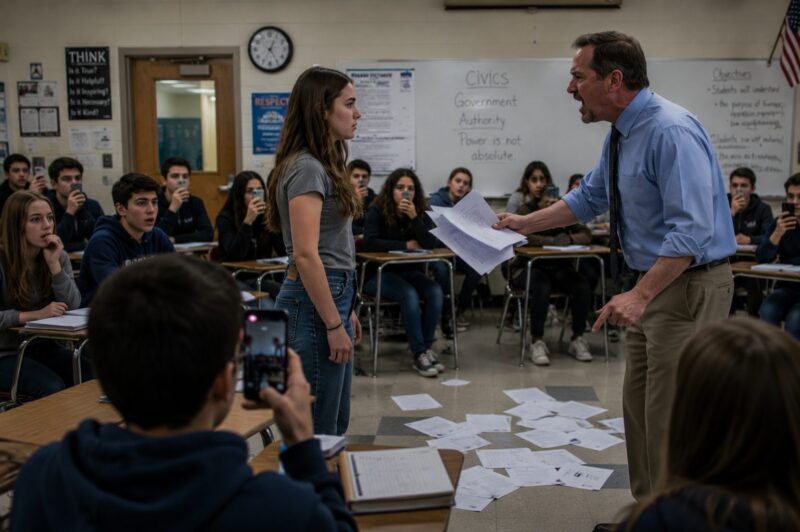
At that moment, the classroom door opened. Principal Vale stepped inside. Behind him stood a woman in a navy blazer,
holding a leather folder. Mara Ellis. The color drained from Mr. Harrow’s face.
The principal looked at the papers scattered across the floor. Then at the phones in the students’ hands.
“What is going on here?”
“Miss Carter disrupted the class,” Harrow said quickly. “She has been unstable since her mother’s death.”
The room went cold.
Ava’s face turned pale, but Mara Ellis stepped forward.
“You do not have the right to diagnose a student in front of her classmates.”
With a trembling hand, Ava picked up one of the pages.
“This is my mother’s statement,” she said. “Three days before she died, she wrote that student records were being falsified at
this school. Those copies disappeared.”
Principal Vale immediately stepped toward her.
“Ava, give that to me.”
Mara moved between them.
“Do not touch the evidence.”
The word evidence rang through the room so sharply that even the students in the back row sat up straighter.
“Did anyone record him throwing those papers?” Mara asked.
One phone rose. Then almost the entire classroom. Marcus spoke quietly.
“I recorded the whole thing.”
That evening, the video spread across town. But people did not stay interested only because of the teacher’s shouting.
They stayed because of the documents. Two days later, former students began writing to Mara Ellis.
“My grade was changed too.”
“I was removed from honors classes too.”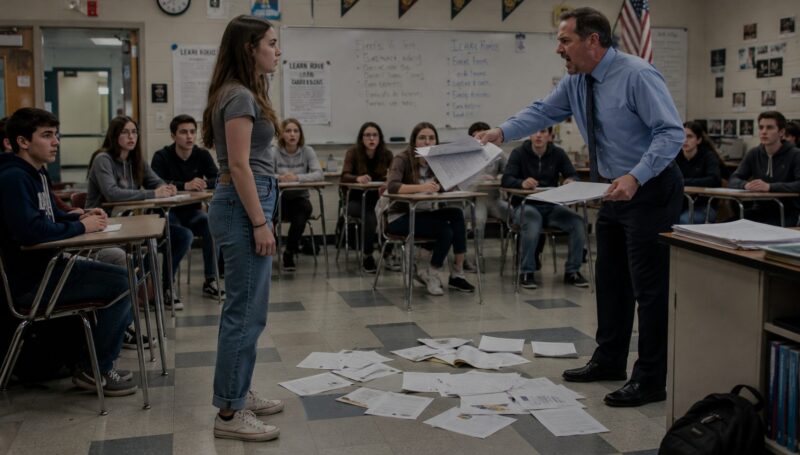
“I complained too, and then they called me problematic.”
The investigation uncovered what the school had hidden for years. Falsified grades. Deleted complaints. Suspicious
donations. And eventually, an invoice connected to repairs on Grace Carter’s car. Her accident was reopened.
Mr. Harrow lost his teaching license. Principal Vale resigned, but that did not save him from the investigation. And Ava stayed
home from school for three weeks — not because she had lost, but because, for the first time, she could breathe.
Two years later, she gave the graduation speech at that same school.
Her hands were shaking as she read from a single sheet of paper.
“I used to think courage meant not being afraid,” she said. “But I was wrong. Sometimes courage is shaking and still refusing
to sit down when someone tries to use authority to make you feel small.”
The auditorium rose to its feet.
Ava looked at the empty chair beside her father, the one they had left for her mother, and finished.
“No one has the right to throw your future onto the floor.”
Years later, students still remembered that day.
The papers.
The shouting.
The phones.
And the girl in the gray T-shirt who refused to sit down.
But Ava always remembered one thing.
Those papers had not been destroyed.
They had finally become visible to everyone.