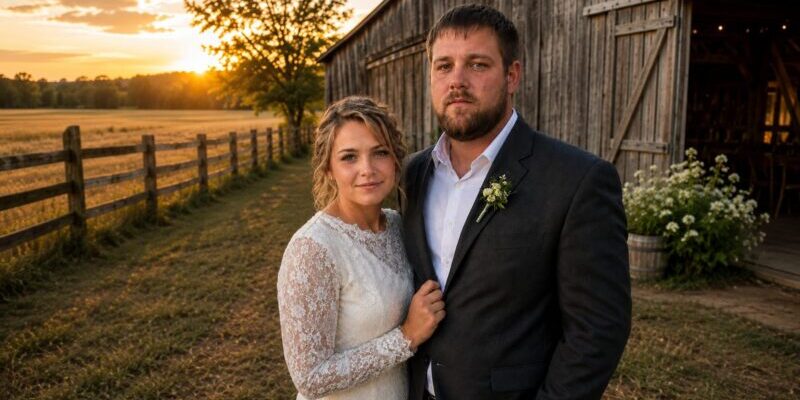
I married my childhood enemy to save our farm, but after the wedding, he took me to the old barn, and the truth inside
destroyed everything I believed 😨💔
I knew my wedding was a trap the moment I saw my father laughing with the man whose name he had spoken with hatred
for twenty years.
He was standing near the drink table, one hand resting on Grant’s shoulder as if they were old friends. And Grant was Tom’s
father. The man my father had always blamed for our misery, our debts, our dried-up fields, and my mother’s silence.
I stood there in my grandmother’s white lace dress, mud already staining the hem, while my new husband stood beside me.
Tom. My childhood enemy. The boy who had lived on the other side of one fence, though for twenty years that fence had felt
like a wall between us. We had been married for only fourteen minutes.
“You’re standing on my dress,” I said quietly.
Tom stepped back.
“Maybe you shouldn’t have worn half a curtain.”
“It belonged to my grandmother.”
He looked at me coldly.
“Then I apologize to the curtain.”
I should have been angry, but my eyes went back to my father. He was laughing. Not politely. Not awkwardly. Really
laughing. And my mother stood beside him with her church smile, the one she always used to hide pain.
I was seven years old when my father first pointed across the barbed-wire fence and said, “That family will bury us if we give
them even one inch.”
That family’s son was Tom.
Sometimes he left apples near my pony’s water trough. I thought it was kindness. But my father kicked them into the mud
and said, “He’s mocking us. He wants us to look weak.”
I was little. I believed him. I stopped waving to Tom. I stopped smiling. And one day, I simply learned how to hate him.
Years later, when both farms were drowning in debt, my father called me into the kitchen. Tom was already there with his
parents. The air felt heavy, as if everyone had already agreed to sell my life before I even entered the room.
“The only way to save both farms is for you two to get married,” my father said.
I laughed at first because I thought it had to be some impossible joke.
But no one laughed with me.
“How does marriage fix a money problem?” I asked.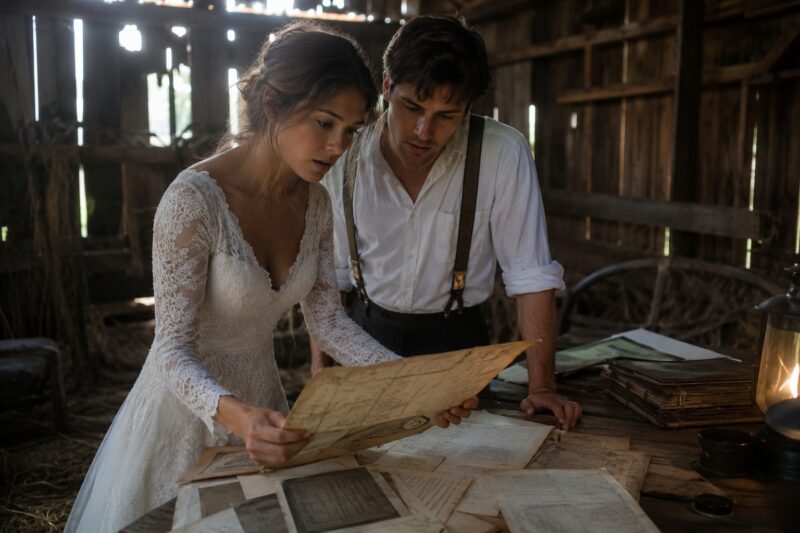
No one answered.
My father only said, “You love this land, Hazel.”
And he knew that was my weakest place.
So I stood beneath a white wedding tent, surrounded by half the county whispering, and married Tom. But when I saw my
father and Grant laughing together, something inside me went cold. Tom leaned toward me.
“Don’t look at them.”
“Why?”
“Because if you look long enough, you’ll understand what I understood. They don’t look like people who made a sacrifice.”
I wanted to walk straight to my father, but Tom grabbed my wrist.
“Hazel, not now. We need to go to the old barn.”
“Why would I go anywhere with you?”
He pulled an old iron key from his pocket. My breath caught. That barn had always been locked. My father had never even
allowed me to touch the door.
“Where did you get that?”
“From my father’s desk. I borrowed it from a liar.”
After those words, I went silent.
We crossed the pasture. The wedding music faded behind us, and ahead there was only wind, crickets, and the old barn.
Tom pushed the key into the rusted lock. It would not turn. I took it from him and twisted hard. The lock groaned open.
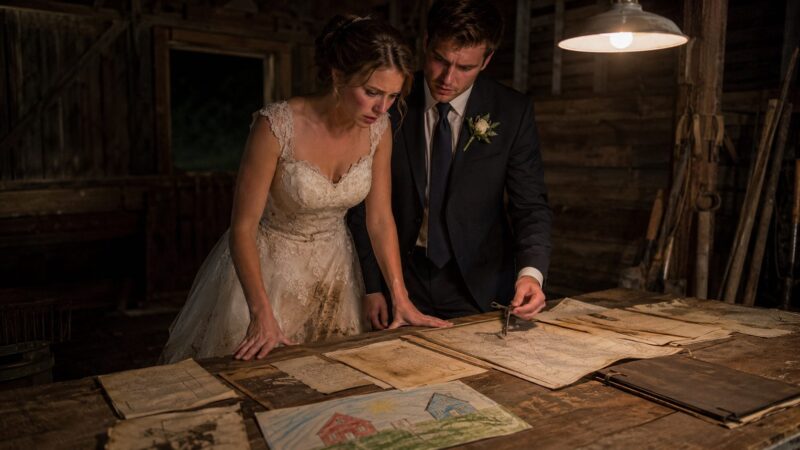
Inside, a lamp swung above a table, and I saw papers, maps, letters, and old boundary markers. At the corner of the table was
a child’s drawing. Two houses. One field. One sun. And no fence. My name was written crookedly in the corner. Hazel.
“I drew this,” I whispered. “When I was seven.”
Tom nodded.
“Before they taught us where the hatred was supposed to be.”
I picked up the map. It showed that our two families had once shared the pasture. The signatures were clear. My father’s
name. Grant’s name.
“My father said your family tried to steal our land.”
“My father said the same thing about yours,” Tom said.
“Then who was lying?”
Tom looked straight into my eyes.
“Both of them.”
I opened another folder. Inside were newer documents. A rescue loan. A debt restructuring plan. Signature lines. My name.
Tom’s name.
The marriage was not meant to save the farm. The marriage made us one household on paper so our parents could place
their debts on our shoulders while keeping the houses, the land, and the control for themselves. My hands began to shake.
“They didn’t want me as a daughter,” I said. “They wanted me as a shield.” The continuation read in the comments 👇‼️
👇‼️
Tom stood silently. For the first time, I did not see an enemy in him. I saw a man who had been lied to, just like me.
I took the papers and walked back to the reception. People were still laughing. My father smiled.
“Hazel, did you and Tom sneak away for a romantic moment?”
I climbed onto the step and ripped the speaker cord from the wall. The music died. The yard fell silent.
“Now I have a question,” I said, holding up the old map. “The fence was a lie.”
My father went pale. My mother closed her eyes.
“You knew,” I said to her.
She said nothing, and that silence hurt more than any words could have.
Grant tried to snatch the folder from my hand, but Tom stepped in front of me.
“Don’t touch it.”
“You’d choose her over your own father?” Grant hissed.
Tom did not move.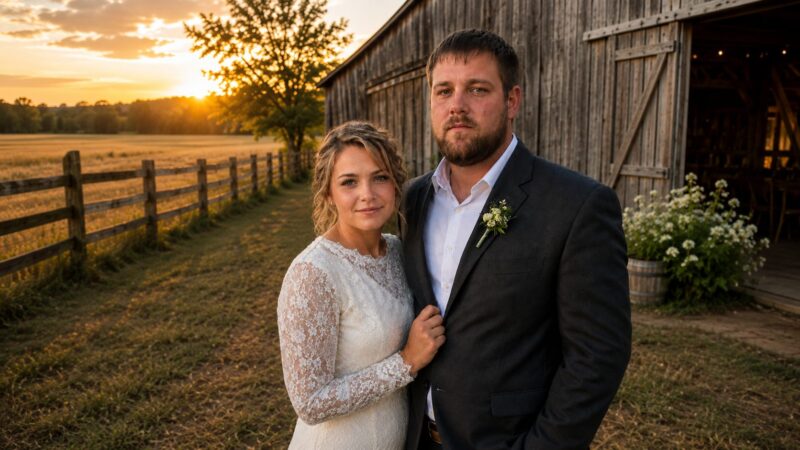
“I choose the truth.”
The next morning, we took the old maps to an elderly clerk who had signed them years before. He stared at the documents for a long time, then said, “They’re real. And don’t sign those new papers unless you want your parents’ mess tied to your lives.”
We returned to Grant’s house. Everyone was waiting there. My father, my mother, Grant, Mary, and a loan officer with a pen in his hand.
“Sign,” Grant said.
I placed the old map over the new documents.
“No. If this plan is fair, remove our names. Open the accounts. Correct the boundary. No hidden debt. No responsibility without authority.”
No one moved.
That silence said everything.
I walked outside, grabbed the wire cutters, and headed toward the fence.
My father followed me.
“Hazel, stop. That fence is there for a reason.”
I cut the first strand.
“Yes,” I said. “To protect a lie.”
Then I cut the second. And the third.
Tom pulled the post from the dry ground, and the field between our homes opened wide, empty, and strangely peaceful.
Tom looked at me.
“Do you still hate me?”
I looked at the fallen fence.
“I haven’t decided yet,” I said. “But I don’t hate the truth anymore.”
For the first time in twenty years, the farm looked whole.
And so did I.