
Hiding under a stranger’s carriage, running from a cruel marriage… Could one woman outsmart injustice and take back
her life? 😱😨
The sunny morning of 1825 had fallen over the courtyards of the San Jerónimo hacienda on the outskirts of Puebla. The pale
blue sky illuminated the blossoming orange trees, the stone fountains, and the tables prepared for a celebration that was
never meant to take place. Catalina de Aranda was wearing a white wedding dress, but that morning her heart felt
something completely different: fear, a silent dread that churned inside her. Her uncle Esteban, Rodrigo Moncada, and his
bribed doctors—all of them—watched over what Catalina did not yet know: her mother’s inheritance was about to become
the key to her imprisonment. Remedios, her old governess, whispered with her worn-out lips: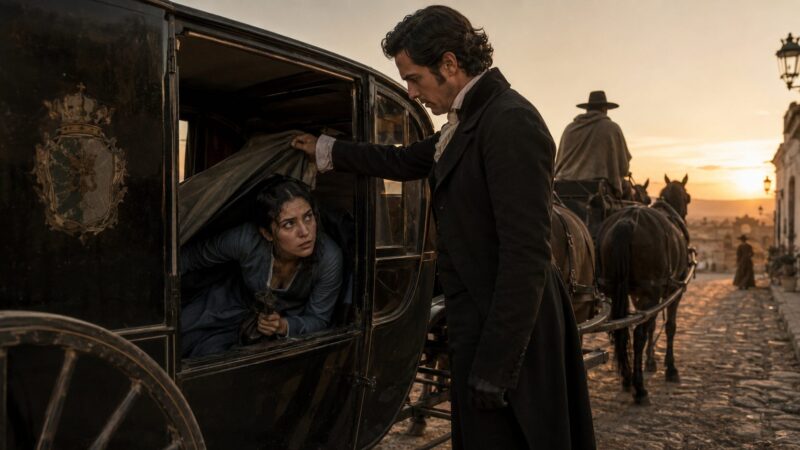
— Read quickly, my girl. Remember, I was behind the door when you weren’t watching.
Catalina unfolded a crumpled letter, and each word—“guardianship,” “relocation,” “bribed doctors,” “detention”—felt like it
slipped beneath her feet. She realized that the wedding was merely a trap: the bride was to be confined in a glass-like cage
so that everything could be controlled until she turned thirty.
— You must leave now, — whispered Remedios, placing a simple blue wool dress in Catalina’s hands. — Even if the guests
are already arriving, no one will see you leave if you go through the service corridor.
— Where should I go? — asked Catalina, tired and anxious.
— Somewhere they cannot find you, — replied Remedios. — Veracruz, the capital, or any road where your name will not
weigh like a chain.
With a small pouch of coins in her hand, Catalina felt, for the first time in her life, the support her mother had left—not as a
debt, but as protection born of love.
She stepped into the courtyard, her legs heavy, but her heart began to race. Outside, the first carriages arrived with noisy
wheels. Catalina passed through the orchard and slipped through an opening in the wall, but as she reached the dirt road,
she heard shouts—she had already been discovered. She no longer hesitated. She ran, her feet tangling, her heart pounding
hard in her chest.
Rounding a bend lined with towering trees, she saw a traveling carriage—black, door half-open, with a watchful man’s eyes
glinting in the moonlight. Catalina quickly hid beneath the seat and pulled the blanket over herself.
— Ready, Your Excellency? — came the driver’s voice.
— Then let us proceed, — replied the man. — I am in no rush.
Catalina didn’t know who this man was. She only realized that, for the first time in her life, no one held power over her.
The carriage traveled long roads through lakes, forests, and dusty fields. Catalina closed her eyes, her chest trembling, the
blanket over her body offering more protection than relief. When they stopped at an inn, she tried to escape, but her legs
would not obey.
— I was running from a cruel man, — she whispered. What happened next read in the comments ‼️👇‼️👇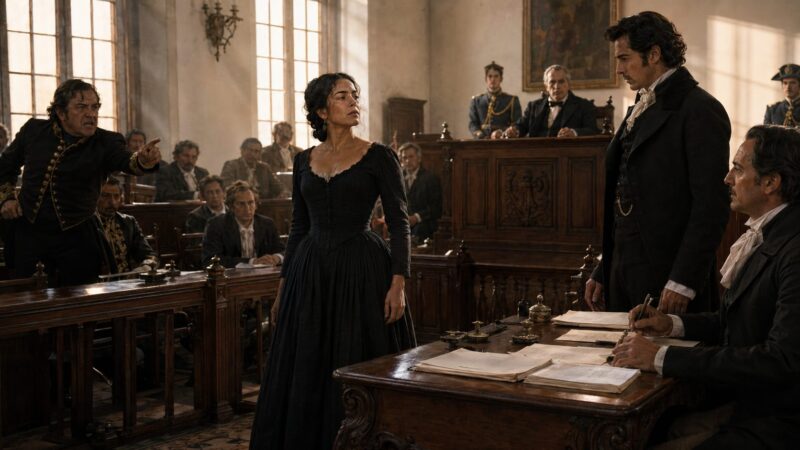
— I already understood, — said the man with piercing eyes. — But are you fleeing from a crime or an injustice?
— From injustice, — Catalina said firmly.
When she opened her eyes, she saw Cristóbal de Valdecañas—tall, stern, yet exuding an aristocratic composure. He didn’t
believe Catalina’s story, yet he did not turn her away.
— Tonight you will stay with me. Tomorrow we will decide what to do. Under this roof, no one will claim you, — he said.
Three days passed. Catalina translated old letters, organized documents, and avoided speaking about herself. But Cristóbal
saw the truth in her eyes, her gestures, the deep sorrow she carried.
— You are Doña Catalina de Aranda, — he said on the third day.
— Yes, — she whispered.
— And today you were to become the wife of Don Rodrigo Moncada, who had already lost two wives within less than two
years of marriage.
By now, it was too late to comprehend the danger Catalina had escaped.
Then came the day when Don Esteban and Rodrigo attempted to seize Catalina at the Valdecañas residence. She hid, but
Cristóbal stood firmly with the documents and his lawyer. The papers, Remedios’ testimony, the old letters—all proved her
true freedom
— If you marry me, — Cristóbal said, — you will no longer be under your uncle’s control. Your fortune will be protected, and
no one can imprison you without confronting my name.
Catalina gazed at him, and with a mixture of despair, fear, and trust, she accepted his offer. The wedding ceremony took
place only for them, without music, celebration, or greedy guests.
And so, the woman who had once hidden beneath a carriage seat finally walked through the halls of her own home—not as
a prisoner, but as the mistress of her fate, loved without chains, and finally free.