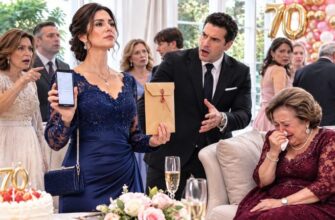
My husband demanded a paternity test immediately after our daughter was born, convinced he would finally catch me
cheating, but the result revealed not my betrayal, but a secret his mother had been hiding for years 😨😱
Adam was standing near the hospital room door, his hands in his pockets, his eyes cold. I was holding our newborn
daughter, Ema, in my arms — tiny, with a pink face and soft little hairs on her head — and I kept whispering to her that
everything was all right. But my heart knew it wasn’t. This time, nothing was all right. Adam, the man I had trusted for five
years, was ready to doubt me before I had even fully recovered from giving birth.
“I want a paternity test,” he said.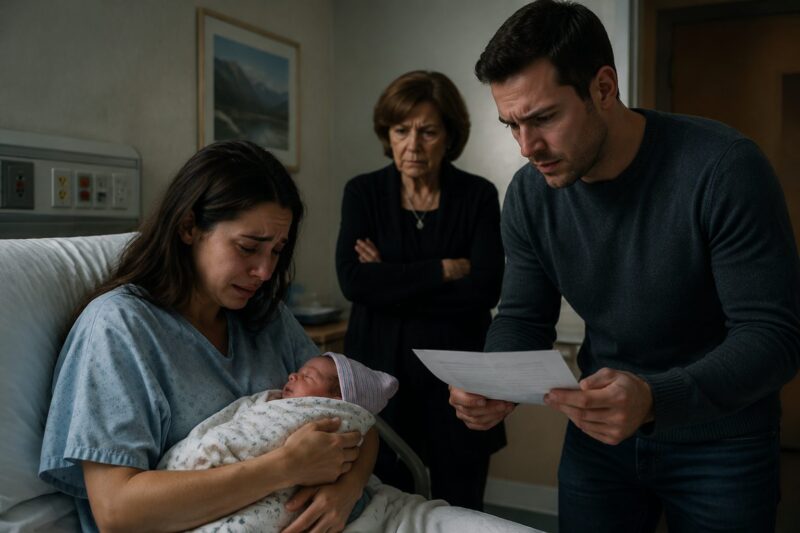
His voice was cold and firm, as if those words alone could reveal the truth. I held Ema tighter against my chest and felt her
gentle breathing against my skin. A wave of fear passed through me. Adam stood there with no warmth in his face, no
tenderness, no hope. His eyes showed neither guilt nor love — only a deep suspicion. Then Vera appeared behind him.
Adam’s mother. She was holding her usual folder in her hand, the one she always carried like a weapon. Her soft but icy
smile seemed to say, I still control everything.
“I’m not accusing you,” Adam said, but his voice carried something that frightened me even more than anger. “But if she is
really mine, one simple test shouldn’t bother you.”
I didn’t believe him. His silence was deeper and crueler than any accusation. And inside that silence was the worst doubt of
all — a doubt Vera had planted in him and watered for years.
“Ema has light hair and blue eyes,” Vera said coldly. “Adam had dark hair as a baby. No one in our family looks like this.”
“She is eight days old,” I answered, exhausted but firm. “A baby’s eye color can change. And my grandmother was blonde.”
Adam said nothing. And that silence broke me more than any insult could have.
“Look me in the eyes, Adam,” I whispered. “And tell me you believe I cheated on you.”
He finally looked at me. For a moment, I hoped I would see shame. Pain. Something human. But all he said was:
“I don’t know.”
Those three words cut through me like ice. After five years together. After every night I had stood beside him.
After every meal where his mother corrected the way I sat, the way I spoke, the way I existed inside their family. I don’t know.
I looked down at Ema. She moved slightly in my arms, unaware that the adults around her were turning love into a
battlefield.
“All right,” I said quietly.
Adam blinked.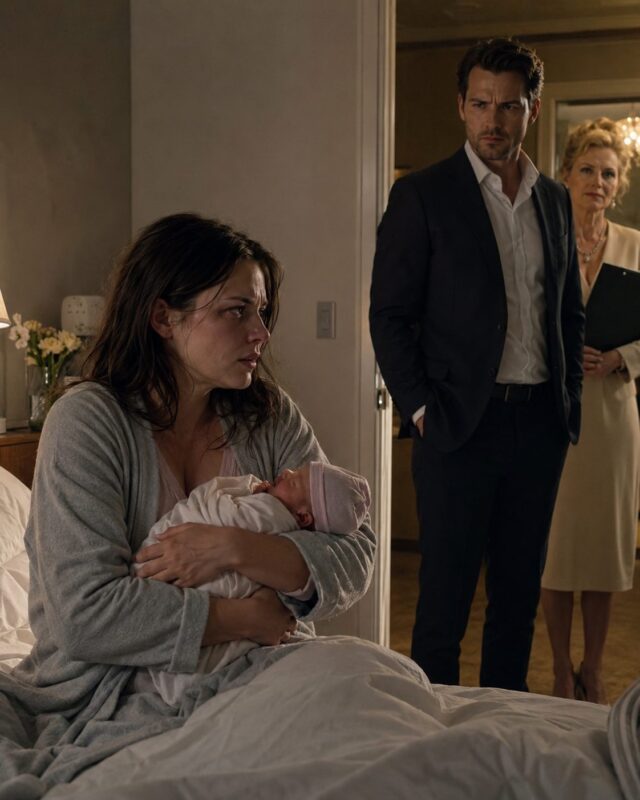
“All right?”
“We’ll do the test,” I said. “But it will be official. At an accredited laboratory. With documents, signatures, and identification.
Just you, me, and Ema. Not through your mother’s clinic. Not through her doctor. Not with some home test that disappears
into someone else’s hands.”
For the first time, Vera’s face changed. Only for a second. But I saw it. It wasn’t fear. It was anger.
“That is unnecessarily complicated,” she said sharply. “Adam has already ordered a test.”
I stared at her.
“Already?”
Adam stiffened.
“I wanted to be prepared,” he muttered.
“Prepared for what?” I asked. “To accuse me before my body had even healed?”
“Don’t turn this into drama,” he said.
I laughed once — a broken, bitter sound.
“I am holding our child in my arms, and you’re telling me you need proof she doesn’t belong to another man. And I’m the
one creating drama?”
Vera stepped forward.
“Women are very emotional after childbirth, Klara. We are only trying to protect Adam’s family.” The continuation read in the
comments ‼️👇‼️👇
Adam’s family. Not ours. Never ours. To Vera, I had never been a daughter-in-law. I had been a temporary vessel for their last
name. And now that vessel had
produced a child she could not control.
I slowly stood up, though pain shot through my body.
“The test will be official,” I said. “Until then, Adam, you will sleep in the study. And your mother will leave this house now.”
Vera’s face turned red.
“This house—”
“Is half mine,” I interrupted. “And the child in my arms is entirely mine until her own father decides whether he has the
courage to be one.”
Adam stared at me.
For the first time, not like a man who could silence me with a tired sigh.
But like a man who had just realized I was no longer begging to be believed.
The week before the results was the longest of my life.
Adam slept in the study. During the day, he moved through the house like a guest who didn’t know where to place his
hands. He never picked Ema up unless I handed her to him. He never asked if he could change her diaper. He never came at
night when she cried.
That was the worst part.
Not because I needed his help.
But because I could see he was careful not to get attached.
As if loving his own daughter before the results came back would make him look foolish.
Then the day came.
The laboratory was white, silent, and cold, almost like a courtroom. Ema slept in her car seat beside me. Adam held the
sealed envelope in his hands. His fingers were shaking.
He opened it.
He read it once.
Then again.
Then a third time.
His face went pale.
I took the paper from him and saw the line in the middle:
Probability of paternity: 99.99998%. The tested man is not excluded as the biological father. The result practically confirms paternity.
I closed my eyes.
Not because I had doubted the truth.
But because even an innocent person can break down when the world finally stops shining a light in her face.
“She’s yours,” I said.
Adam whispered:
“I know.”
“No,” I answered. “You didn’t know. That’s why we’re here.”
But there was something else in his eyes now.
Not relief.
Horror.
“Klara,” he said slowly, “if this is true… then the document my mother showed me…”
He didn’t finish.
He didn’t need to.
Years ago, Vera had told Adam he might not be able to have children. She had shown him a medical paper after an old sports injury, claiming his chances of fatherhood were almost impossible.
And she had brought that paper back the moment Ema was born.
Not before the wedding.
Not when we were trying for a baby.
Only after she saw our daughter.
Because that paper was never about protecting Adam.
It was a weapon.
Adam called Vera right there, in the car, and put her on speaker.
“The result came,” he said.
“And?” Vera asked.
“She’s mine.”
Silence.
Not joy.
Not relief.
Silence.
Then Vera said:
“That’s impossible.”
Adam closed his eyes.
And in that sentence, we both heard the truth.
Not Thank God.
Not I’m sorry.
That’s impossible.
“Why?” Adam asked quietly.
“Because… because the test must be wrong.”
“It was official,” he said. “Done at the laboratory.”
“You shouldn’t have done that,” Vera snapped.
Adam’s face turned even paler.
“What do you mean?”
“I mean you should have let me choose the clinic. I know people who could have—”
“Who could have what, Mother?”
She went silent.
And for the first time, Adam’s voice became firm.
“Show me the document about my infertility.”
“This is not the right time.”
“Show it to me.”
“Don’t let Klara manipulate you. She is turning you against your family.”
“No, Mother,” Adam said. “You turned me against my wife and my daughter.”
Then he ended the call.
The truth came out piece by piece after that.
The old medical document was fake. Adam had never had a full fertility examination. Vera had created the lie to keep him afraid, dependent, and obedient.
But the worst secret was hidden in his late father’s will.
Adam’s first biological child was supposed to receive a share of the family company through a trust fund. Until that child was born, Vera kept control. If Ema could be declared not Adam’s daughter, the trust would never exist — and Vera would keep everything.
Suddenly, everything made sense.
Her suspicion was not about morality.
It was about money.
Her hatred toward me was not just pride.
It was fear of losing control.
And her words — “That’s impossible” — were not a mother’s shock.
They were the scream of a woman whose plan had just collapsed.
I left with Ema and went to my sister’s house.
Adam didn’t stop me.
He helped put the bags in the car and stood on the sidewalk as we drove away, looking like a man whose house had burned down — and who had only just realized he was the one who lit the match.
Months passed.
I did not forgive him quickly.
He went to therapy. He learned to change Ema’s diapers, to hold her when she cried, to stay instead of handing her back to me. He learned that being a father was not a right stamped on paper, but a promise proven every day.
On Ema’s first birthday, he came with a cake and a small gift. He helped blow up balloons, cleaned after the party, and stood quietly by the door before leaving.
“Thank you for letting me be here today,” he said.
I looked at Ema, sitting on the blanket with frosting on her cheeks.
“You weren’t here because of me,” I said.
“I know,” he answered.
After he left, I found an envelope on the table.
Inside was a copy of the paternity test.
At the bottom, Adam had written one sentence by hand:
“She never had to prove she was mine. I had to prove I deserved to be her father.”
One day, when Ema is older, she may ask why her parents once stood so far apart.
I will not tell her that her father didn’t love her.
That would not be true.
I will tell her that sometimes people inherit fear before they learn courage. That love without trust can wound. That paper can prove blood, but character is proven only by what a person does after realizing they caused pain.
And I will tell her the most important thing.
The day her father asked for a paternity test, her mother stopped begging to be believed.
Because she already knew the truth.
She was holding it in her arms.
It was breathing against her neck.
And her name was Ema.