
Just three days after my son’s death, my daughter-in-law stood in my bedroom doorway and said, “This house is no longer
yours. You have until the end of the week to leave.” 😱💔
I was sixty-eight years old when I lost my only son, Michael.
His death was so sudden that during the first few days, I could not even understand why people dressed in black kept
coming to our house, why they hugged me, or why they whispered that I had to stay strong.
How could a mother stay strong when, only three days earlier, her son had been sitting in the same kitchen, drinking the
coffee she had made and saying,
“Mom, we’ll take you out of town on Sunday. You need some fresh air.”
Sunday came. But Michael did not. We buried him on Saturday morning.
My daughter-in-law, Sarah, cried throughout the entire funeral. She held my hand so tightly that I even thought all the
arguments we had had over the years had finally become meaningless.
Sarah and I had never been close. She believed I interfered too much in their lives. I felt that she had slowly pulled my son
away from me. But after Michael’s death, the two of us were left alone in the same empty house. I thought grief might finally
bring us closer. I was wrong.
Three days after the funeral, Sarah entered my bedroom. There were no tears on her face anymore.
She crossed her arms and said without looking me in the eyes,
“I spoke to a lawyer. The house was in Michael’s name. Now it belongs to me.”
At first, I did not understand.
“What are you trying to say?”
“I’m saying I’m going to sell the house. You need to find somewhere else to live by the end of the week.”
I looked around the room.
Forty years earlier, my husband had painted those walls. I had waited by that window for Michael to come home from school.
I had cared for my sick husband in that house until his final breath.
“Sarah, this is my home,” I barely managed to say.
She gave me a cold smile.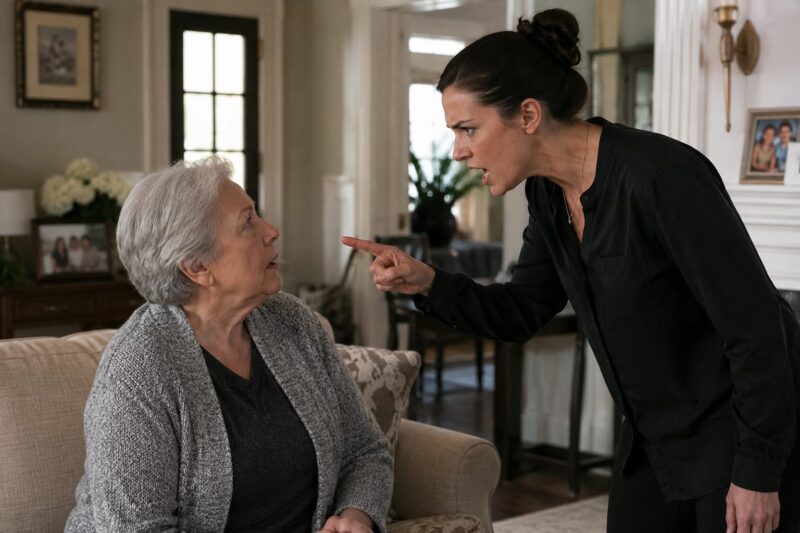
“Maybe it used to be. But according to the documents, it isn’t anymore.”
That evening, I sat in the kitchen until late at night.
Upstairs, Sarah was speaking to someone on the phone. I heard only one sentence.
“Yes. As soon as the old woman is gone, we can finish the deal.”
“The old woman.”
That was what she called me inside my own home. The next day, she placed two empty boxes outside my bedroom door.
“These are for your belongings,” she said.
I began packing my clothes. Not because I had accepted defeat, but because I no longer had the strength to fight.
When I opened my husband’s old wardrobe, the smell of dust filled the room. No one had opened it in years. At the back, I
noticed a small wooden box. Inside were his watch, several old photographs, and a yellowed envelope.
My name was written on it. My hands began to shake. Inside was a document signed by my husband, a notary, and two
witnesses. I read the same lines several times.
The house had never fully belonged to Michael.
Before his death, my husband had placed it in a family trust. According to the agreement, I had the legal right to live there
for the rest of my life. No one could sell it without my signature. But there was another clause at the bottom of the
document.
If anyone ever tried to force me out or sell the house through deception, ownership would immediately be transferred to
another person. When I read that person’s name, I stopped breathing. The continuation read in the comments ‼️👇‼️👇
Sarah Miller.
My daughter-in-law’s name was written there. I did not understand why. The next morning, I went to see a lawyer. He
studied the document for a long time, then asked,
“Did you know that your son tried to use the house as collateral two months ago?”
I froze. The lawyer explained that Michael had been deeply in debt. He had borrowed money without telling Sarah and had
even tried to forge my signature.
“Your daughter-in-law discovered it,” the lawyer said. “She stopped the transaction.”
I no longer understood anything. When I returned home, Sarah had already placed my suitcase in the hallway.
I put the document on the table. Her face turned pale.
“Where did you find this?”
“In the wardrobe. Now tell me what is really happening.”
Sarah remained silent for a long time. Then she sat down and, for the first time, began crying in a way she had not even cried
at the funeral.
“Michael used this house as collateral,” she whispered. “He owed money to dangerous people. After his death, they came to
me. They said that if I didn’t sell the house by the end of the week, they would hurt both of us.”
“That’s why you were trying to throw me out?”
“I wanted to send you to stay with my sister. I thought that if you were not here, at least you would be safe.”
I looked at her and realized that I had been blaming the wrong person all along.
But at that exact moment, someone pounded violently on the front door.
Sarah wiped away her tears and stared at me in terror.
A man’s voice came from outside.
“Sarah, your time is up. Bring us the contract.”
I took her hand.
“No,” I said. “This time, no one is forcing us out of our own home.”
And when I opened the door, the men still did not know that the lawyer had already called the police.
That day, I did not only save my home.
I finally understood that my daughter-in-law had never been my enemy.
She had simply been trying to protect us alone from the secrets my son had taken with him to the grave.