My daughter always begged to stay with grandpa, but after hearing one sentence she repeated, Idecided to secretly
return… 😨💔
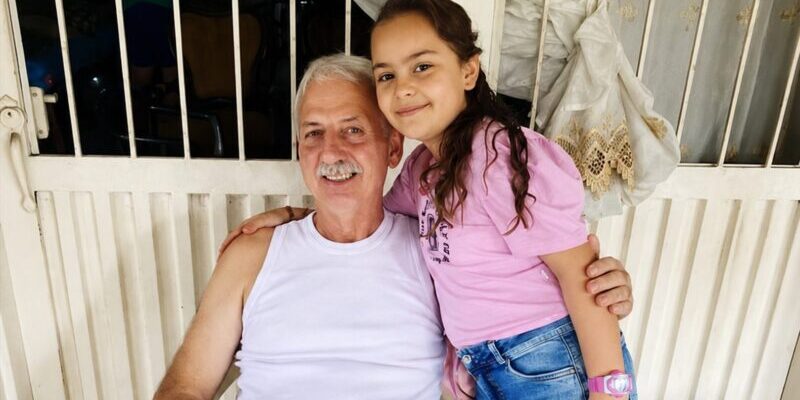
My seven-year-old daughter, Emily, had always been very close to my father, George.
After my mother died, Dad lived alone in our old family home. He was already seventy-two, but he still did his own shopping,
cared for his garden, and baked Emily’s favorite apple pie every Sunday.
At first, I was happy that they were so close. But in recent months, Emily had started making the same request after every
visit.
“Mom, can I stay at Grandpa’s again tonight?”
Whenever I said no, she would become unusually serious.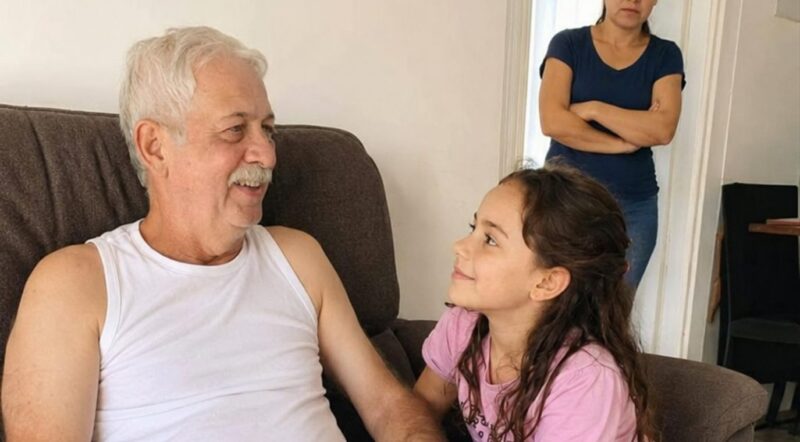
“But Grandpa is alone. He needs me to stay here.”
I allowed it several times. My father was someone I trusted, and it had never occurred to me that I should be concerned. But
Emily’s behavior soon began to change. She stopped telling me what they did together.
“It’s a secret,” she would say before quickly changing the subject.
One Sunday, when I went to pick her up, I noticed that the door leading to the second floor was locked. That door had never
been locked before.
“Why is it locked?” I asked my father.
His smile immediately disappeared.
“There are old things up there. It isn’t safe for a child.”
At that moment, Emily walked out of the kitchen and silently looked at Grandpa. There was something in the way they
exchanged glances that I couldn’t understand. On the drive home, I asked my daughter whether anything was troubling her.
“No, Grandpa is very nice,” she answered quickly.
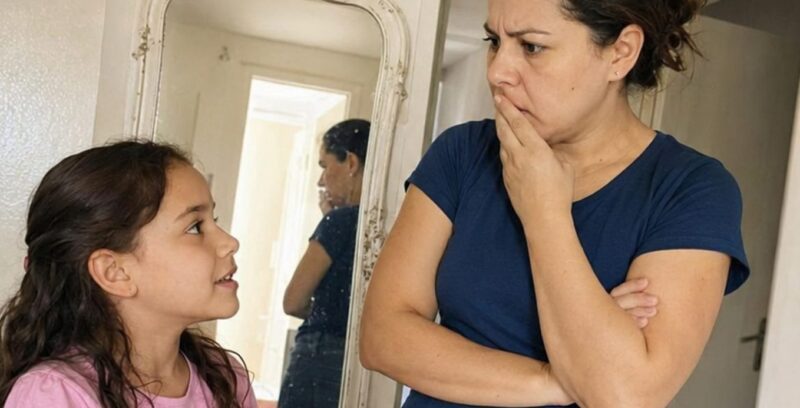
That evening, Emily stood in front of the mirror and studied her reflection. Then she turned toward me.
“Mom, do you know what Grandpa told me?”
“What?”
“He said I have a very beautiful figure and that soon everyone will notice it.”
My blood ran cold. I tried to remain calm.
“When did he say that?”
“Yesterday, when we were in the upstairs room.”
“And what were you doing there?”
Fear appeared on Emily’s face.
“I can’t tell you. I promised.”
I didn’t sleep that night.
I kept thinking about the locked door, the secrets, and the uneasy expression on my father’s face. I tried to convince myself
that perhaps Emily had misunderstood his words, but as her mother, I couldn’t simply ignore them.
The following day, I called my father and told him I needed to leave Emily with him for a few hours. He agreed, but there was
a strange tension in his voice.
After sending my daughter inside, I pretended to drive away. I parked on a nearby street and returned ten minutes later.
The front door was unlocked. The house was silent. Then I heard my father’s voice coming from upstairs.
“Stand straight. Just like that. You have exactly the right proportions.”
Emily giggled softly.
“When will Mom see it?”
“Not yet. She might be frightened. We have to finish it first.”
My heart began pounding.
I walked upstairs and saw that the previously locked door was partly open. I put my hand on the handle and stepped inside.
“Get away from my daughter!”
My father spun around in shock. Emily was standing in the center of the room, wearing completely ordinary clothes. Beside
her was something large covered with a sheet, while pieces of wood, paint, and tools were scattered across the floor.
“Mom, you weren’t supposed to see this!” Emily exclaimed.
I immediately pulled her close to me.
“What is going on here?”
My father had gone pale.
“Claire, I can explain.”
“Start by explaining why you told my daughter she had a beautiful figure.” What happened next read in the comments ‼️
👇‼️👇
He remained silent for several seconds. Then he approached the object in the center of the room and pulled away the white
sheet. I stepped back, confused by what I saw. It was a wooden statue of a little girl.
The face was still unfinished, but the clothes, hair, and posture resembled Emily.
“A new children’s library is opening in town,” my father explained. “They asked me to create a sculpture of a young reader for
the entrance. Emily wanted to be the model. When I said she had a ‘beautiful figure,’ I was talking about the proportions of
the sculpture. It was a poor choice of words. I should have spoken more carefully.”
For a moment, I felt relieved. But then I remembered everything else.
“Then why were you hiding it from me?”
Emily looked at Grandpa, and his eyes filled with tears.
“Because the sculpture wasn’t the real secret,” my father said. “The secret was something else entirely.”
He opened the lowest drawer of a cabinet and removed several hospital documents.
Two months earlier, he had been diagnosed with an early-stage neurological illness. The doctors had warned him that, over
time, he might lose precision in his hands and begin experiencing memory problems.
“This may be my final sculpture,” he whispered. “I didn’t want to tell you until I was certain. You already have enough worries.”
At that moment, I understood why Emily always wanted to stay with him.
“Did you know?” I asked my daughter.
She nodded.
“One day, Grandpa forgot to end a phone call, and I heard what the doctor said. He asked me not to tell you. I stayed because
his hands shook at night. I brought him water and made sure he took his medicine.”
None of the story I had feared was real. The truth was far more painful. I knelt in front of Emily and wrapped my arms around
her. Then I looked at my father.
“No more secrets. Especially secrets that a child is expected to keep.”
My father nodded.
“You’re right. I gave her a responsibility that should never have belonged to a child.”
The following week, I went to the doctor with my father. We arranged his treatment, and we explained to Emily that caring
for adults was not her responsibility. We also made sure she understood that she could always tell me about any secret or
comment that made her uncomfortable.
Three months later, the completed sculpture was placed outside the entrance to the library—a little girl holding an open
book.
On opening day, my father stood beside Emily, and she proudly held his hand.
Only one sentence was written on the statue’s base:
“For the children who teach us that the truth should never remain a secret.”