They laughed at black woman while filming her public humiliation… But days later, she did something that made everyone
get shocked , the revenge she did was surprising 😨😱
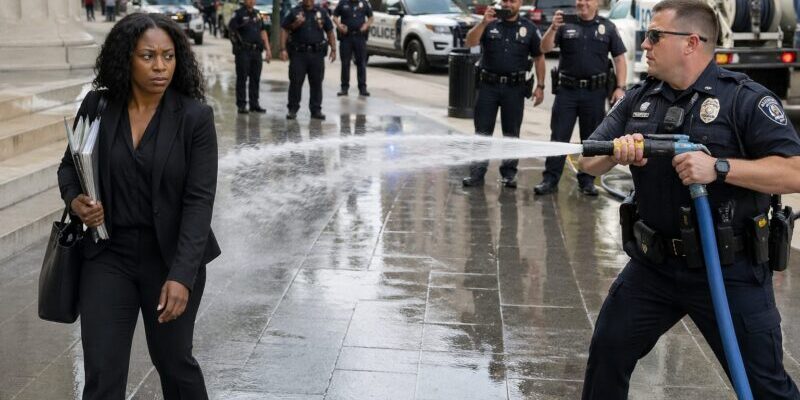
That morning, Camila was walking toward the courthouse with important case files tucked under her arm. The square felt
strangely quiet. Near the courthouse entrance, several police cars had blocked the road in a semicircle. Beside them stood a
street-cleaning truck. The officers were laughing.
Among them stood Trent Malloy, an arrogant, broad-shouldered officer who had hated Camila for a long time. He held the
hose in his hands and stared at her with a cruel smile.
“Well, boys,” he shouted,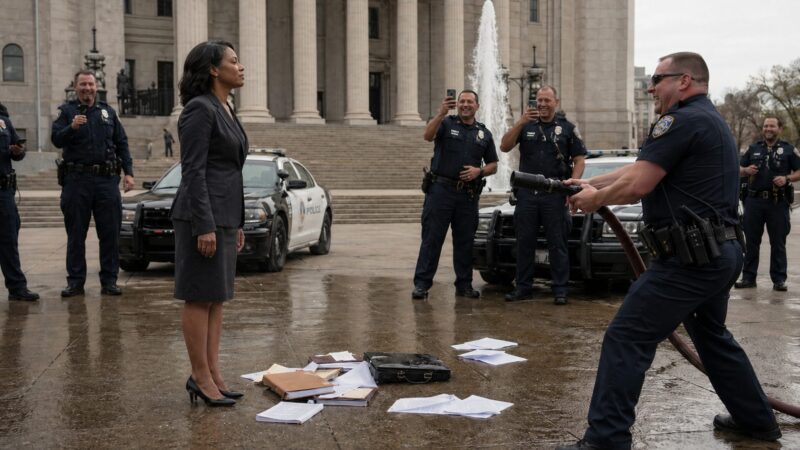
“today we’re going to cool down our queen.”
Camila stopped.
“Malloy, what are you doing?”
He didn’t answer. The next second, a powerful stream of freezing water slammed into Camila’s chest. She stumbled
backward, her folders burst open, and the documents scattered across the wet pavement. The officers exploded with
laughter. Several of them were filming on their phones Malloy stepped closer, leaning toward her with a grin.
“What did you think, Judge? Who are you going to complain to? Us?”
Camila was soaked, humiliated, but not broken. Slowly, she straightened up, locked eyes with Malloy, and said coldly … Read
in the comments 👇‼️👇‼️
“I memorized your face, your voice, and your badge number.”
The laughter died for a moment.
Camila gathered the soaked papers and walked into the courthouse. In her office, she changed clothes, sat at her desk, and
immediately filed an official complaint. She demanded that all surveillance footage be preserved and that every officer
present in the plaza be identified.
A short time later, Judge Russell Keene, her longtime colleague, entered her office.
“Camila, this wasn’t ordinary cruelty,” he said.
“This was a message.”
“I know,” she replied calmly.
“The question is who gave them permission to send it.”
At that moment, her assistant entered holding a white envelope.
“This was left at your door.”
Camila opened the envelope. Inside was only one sentence:
“Malloy wasn’t acting alone.”
Two days later, Internal Affairs summoned Camila for questioning. She went with her attorney, Nina Alvarez. Inside the
precinct, officers stared at her with cold hatred. The investigator, Detective Slack, tried to frame everything as a mistake.
“Perhaps the truck simply malfunctioned?” he asked.
Camila didn’t blink.
“A malfunctioning truck doesn’t shout, ‘Let’s cool down our queen.’”
Nina leaned forward.
“And a malfunctioning truck doesn’t make five officers turn on their cameras in advance.”
Slack fell silent.
That evening, a second envelope appeared on Camila’s desk. Inside was a photograph from the moment of the attack. In the
photo, female officer Dana Kross could be seen standing with a phone in her hand. Her badge number was clear: 4127. On
the back of the photograph, someone had written:
“She didn’t do everything willingly. Not everyone wanted this.”
Soon, the video appeared online. The entire city saw Malloy blast the judge with water while the other officers laughed. At
first, the police chief tried to call it an “operational mistake,” but it was too late. The case reached federal authorities.
The investigation was taken over by Special Prosecutor Rebecca Lang. She met with Camila and placed a thick folder on the
table.
“This isn’t just about Malloy,” Lang said.
“We’ve found a corruption network. Officers, officials, judges, and contractor Mark Vale. For years, they have intimidated
everyone who stood in their way.”
“And I stood in their way?” Camila asked.
“You were supposed to preside over Vale’s case,” Lang replied. “They wanted to humiliate you so you would recuse yourself.”
The investigation uncovered deleted messages, secret chats, and recordings. For weeks, Malloy had been writing that they
needed to “humble the judge.” One of his superiors had instructed him:
“Make sure she understands who runs this city.”
In court, Malloy tried to defend himself.
“It was just a joke,” he said in a trembling voice.
Prosecutor Lang played his own recording.
“Tomorrow the whole city will see our great judge soaked.”
Silence fell over the courtroom. After a six-week trial, the jury returned. Malloy stood pale, sweating, stripped of all his former
confidence.
“Guilty,” the jury foreperson said.
A few seconds later, again:
“Guilty.”
And again:
“Guilty.”
That same day, officers, commanders, city officials, and Mark Vale were arrested. The entire police leadership was removed.
Secret accounts were frozen, locked cabinets were opened, and the people who had spent years laughing at others’ pain
began giving up one another’s names.
After the verdict, Camila stepped out onto the courthouse steps. Hundreds of people had gathered in the plaza. They
applauded, cried, and shouted her name. But in the distance, the allies of the old system still stood, watching with cold,
hateful eyes.
Camila stood before the very place where she had been humiliated and said loudly:
“You cannot intimidate justice. You cannot drown the truth. And you cannot silence an entire city forever.”
The crowd erupted in applause.
At that exact moment, her phone buzzed with a message from young Officer Liam Pearson, who had secretly helped the
investigation:
“They’re not done. Be careful. They still have allies.”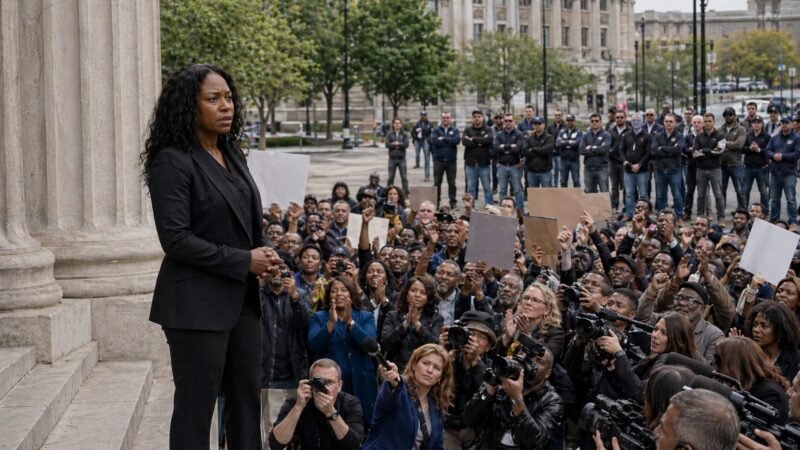
Camila stared at the screen for a long moment. Then she raised her eyes toward the people standing in the distance and
smiled coldly. She wrote only three words:
“So do I.”
In the following days, federal agents’ vehicles entered the city again. Doors were opened, names were exposed, and new
arrests followed. Some tried to run, some cried, and others begged for deals.
Camila returned to her judicial chair—calm, motionless, and merciless. Every time another defendant lifted their eyes and
saw her, they understood one thing: the woman they had tried to humiliate in front of everyone had become their final
verdict. They did not break Camila Hartman with cold water. They awakened her.