My mother-in-law insisted that my baby always cried during bath time because “It was normal.” But one day, I saw red dots
on his body and realized she was hiding a terrifying secret from me… 😱💔
When my son, Lucas, turned three months old, I had to return to work.
My husband, Daniel, worked all day, and we couldn’t afford to hire a nanny. My mother-in-law, Margaret, offered to help.
“I raised three children,” she said. “Besides, I worked as a nurse in a pediatric ward for twenty years. Don’t leave the baby with
a stranger.”
At first, I was grateful. Margaret came to our house every morning, fed Lucas, changed his diapers, and took him for walks.
Only one thing worried me. Every time she gave Lucas a bath, he cried hysterically.
It wasn’t ordinary crying. He screamed so loudly that his tiny body stiffened and his face turned red. Several times, I rushed
into the bathroom, but I always found Margaret standing near the bathtub with Lucas wrapped in a towel.
“What happened?” I would ask.
“Nothing. He simply doesn’t like water.”
“But he doesn’t cry like that when I bathe him.”
She would look at me with annoyance.
“Babies behave differently from one day to the next. I’m older than you, Emily. I know better what is normal.”
Her confident voice made me doubt my own instincts.
One day, I returned home from work early. The moment I opened the front door, I heard Lucas screaming. I ran toward the
bathroom, but the door was locked from the inside.
“Margaret, open the door!” 
Something fell onto the floor inside. A few seconds later, the door opened. My mother-in-law was pale. Lucas was in her
arms, tightly wrapped in a towel.
“Why did you lock the door?”
“To keep the cold air out.”
I reached for my baby, but she stepped backward.
“I’m not finished yet.”
For the first time, I felt truly afraid.
“Give me my child.”
She reluctantly handed Lucas to me. His little body was trembling, but as soon as I held him against my chest, he gradually
calmed down. Margaret quickly gathered her things and left, saying she had a headache.
That evening, while changing Lucas’s clothes, I noticed a tiny red dot on his left foot. Then I saw another.
The marks weren’t random. They were very small and located around his heel and the sides of his toes.
When I carefully examined his other foot, I found more red marks. Some were fresh, while others had already darkened.
My heart tightened.
“Daniel!” I screamed.
My husband rushed into the room. When I showed him the dots, the color drained from his face.
“Maybe they’re insect bites.”
“On both feet? In exactly the same places?”
I immediately called the pediatrician. He told us to take the baby to the hospital as soon as possible.
While Daniel dressed Lucas, I went into the bathroom. I didn’t know what I was searching for, but I could feel that the answer
was hidden there. What happened next read in the comments ‼️👇‼️👇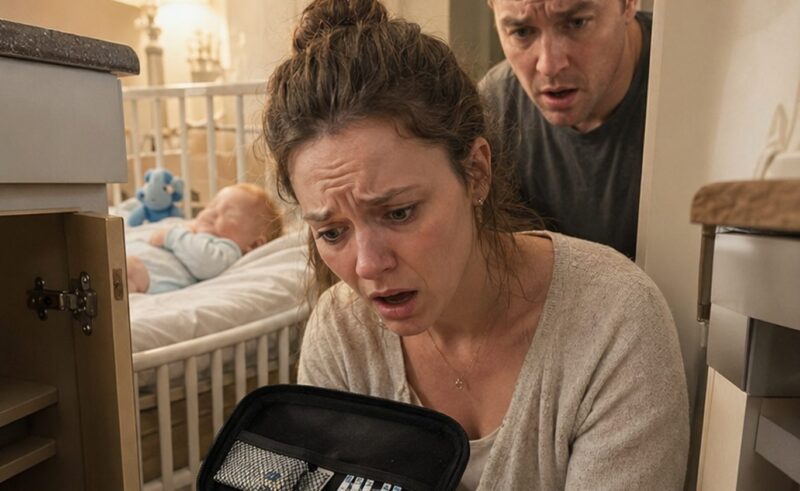
I opened the cabinet beneath the sink. Behind a pile of towels, I found a small black bag I had never seen before.
Inside was a blood glucose meter, used test strips, disposable lancets, and a notebook filled with handwritten records.
There were numbers beside each date. Some had been circled in red ink. On the final page, Margaret had written:
“The reading is dangerously low again. Don’t tell Emily until I’m certain.”
My hands began to shake.
Margaret had been secretly pricking my baby’s feet.
At the hospital, I showed the doctor the bag and the notebook. He immediately ordered blood tests.
An hour later, the doctor returned with a serious expression.
“Your baby’s blood glucose level is dangerously low. If this hadn’t been discovered in time, the consequences could have been devastating.”
I looked at Daniel. He seemed frozen.
“But how did my mother-in-law know about this?” I asked.
Before the doctor could answer, the hospital room door opened.
Margaret stepped inside. Her eyes were filled with tears.
“Because I already lost one child to the same condition,” she whispered.
Daniel slowly turned toward his mother.
“What child?”
Margaret sank into a chair and covered her face with her hands.
“Your brother.”
Silence filled the room.
Daniel had always believed that his older brother had been stillborn. But now Margaret revealed the truth.
The baby had lived for eleven days. He had constantly appeared sleepy, refused to eat, and sometimes trembled. At first, the doctors told Margaret that this could be normal behavior for a newborn.
By the time they discovered his dangerously low blood sugar, it was already too late.
Years later, doctors told Margaret that the condition might be hereditary.
“When Lucas was born, I noticed the same signs,” she said through her tears. “He wasn’t crying because of the bathwater. I put his foot in warm water so the blood would flow more easily. Then I pricked his heel. I know I had no right to do it in secret.”
“Why didn’t you tell us?” I asked, barely able to control my anger.
“Daniel didn’t know about his brother. My husband forced me to remain silent. He didn’t want anyone to think there was an inherited illness in our family. I was terrified to admit that I had been lying for thirty years.”
Tears filled Daniel’s eyes.
“You could have simply told us the truth.”
“I know. But when I saw the first low reading, I panicked. I wanted to make certain. Then, with each passing day, I became more afraid.”
I couldn’t forgive her for secretly causing my baby pain. But I also couldn’t ignore the fact that her notebook had helped the doctors discover his condition in time.
Lucas was diagnosed with a rare inherited disorder that caused his blood sugar to drop suddenly. Treatment began that same day.
The doctor told us that if we had waited a few more weeks, the story might have ended very differently.
Margaret had saved her grandson.
But she had done it with the same silence that had once cost her own son his life.
When Lucas was finally released from the hospital, I allowed Margaret to visit him—but only when Daniel or I was present.
She approached the crib, took his tiny hand, and began to cry.
“Forgive me,” she whispered. “I was so afraid of losing you that I forgot secrets can cause harm too.”
From that day forward, Lucas never cried during bath time again.