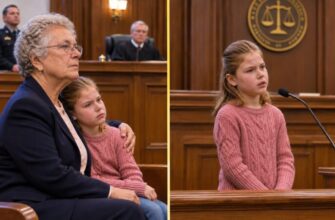
Our son said he needed to sell our house to pay off his debts, then we heard the real reason he wanted us gone 😱💔
I am seventy-three years old, and my husband, Harold, is seventy-six.
We had lived in that house for forty-two years. It was where our two children grew up, where our grandchildren took their
first steps, and where the little pencil marks showing our son’s height still remained on the kitchen wall.
But one evening, our son, Michael, sat down across from us and said:
“This can’t continue anymore. I’m tired of you.”
At first, I thought I had misheard him.
For the past few months, Michael had been visiting us often. In the beginning, he said he was worried about our health. He
brought groceries, changed burned-out lightbulbs, and sometimes drove my husband to the doctor.
I was even happy about it.
“See?” I would tell Harold. “Our son hasn’t forgotten us.”
But soon, Michael’s behavior began to change.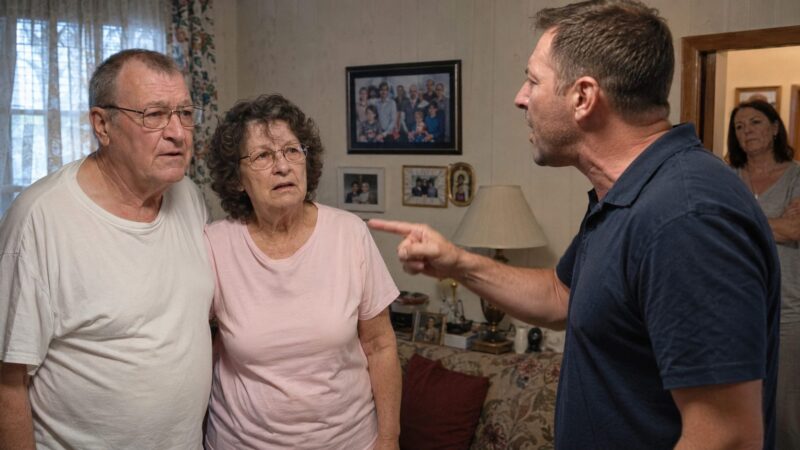
He started complaining that the house was too old, that we moved too slowly, and that his father kept repeating the same
stories. If I asked him to stop by the pharmacy, he sighed. If Harold needed help going up the stairs, Michael looked at his
watch. One day, he said loudly:
“I have my own family. I can’t keep running over here every day.”
We had never asked him to come every day. He came on his own.
Then he started talking about selling the house.
“You don’t need this much space,” he said. “It would be better if you moved into a smaller apartment. Or a good nursing
home.”
My husband stayed silent every time. But I could see his fingers tightening around the edge of the table.
Harold had renovated that house with his own hands. He had worked night shifts at a factory for years so he could pay off
the mortgage early. Every room carried some trace of his work.
And now our son spoke about that house as though it were nothing more than an empty building.
That evening, Michael did not come alone. His wife, Jessica, was with him. She did not even take off her coat. She sat on the
sofa, placed her phone on her knees, and said:
“We’ve already spoken to an agent.”
I looked at her.
“What agent?”
Michael took a deep breath, as if we were the ones placing him in a difficult situation.
“A real estate agent. The house needs to be sold.”
Harold finally spoke.
“And who are you to decide whether our house is sold?”
Michael’s face turned red.
“I’m your only son. I’m the one dealing with all your problems. I’m the one taking you to appointments, checking your bills,
and thinking about fixing the roof. You can’t live independently anymore.”
“We still pay our own bills,” I said calmly.
“But for how long?” he snapped. “I’m tired of being afraid every time the phone rings. I’m tired of wondering whether Dad
has fallen or whether you’ve left the gas on.”
I froze. A few weeks earlier, I had forgotten to turn off the stove. But Harold had noticed only a few minutes later. Nothing
had happened. Michael was now using that incident as proof that we no longer had the right to control our own lives.
“You’re moving,” he said. “We’ve already found a place. Tomorrow, the agent is coming to take pictures of the house.”
Jessica raised her head for the first time.
“It’s better for you too. They provide meals and nurses there. Here, you’re only becoming a burden to us.”
After hearing those words, Harold slowly stood up. His legs had been hurting lately, but at that moment, he stood completely
straight.
“I built this home with your mother,” he said. “We brought you here from the hospital. I worked two jobs for you. We paid off
your student loans. When your business failed, we took out a loan against this house to save you.”
Michael looked away.
“I’m grateful for that. But that was in the past.”
Harold remained silent for a moment.
“You’re right. It was in the past.”
He walked into our bedroom and returned carrying an old brown folder. He placed it on the table but did not open it.
Michael smiled.
“The documents, right? Great. We’ll need those tomorrow.”
“No,” Harold replied. “You won’t need them tomorrow.”
He opened the folder and removed the property deed. Michael leaned forward. Then his smile disappeared. The house was
no longer in our names. The continuation read in the comments 👇‼️👇‼️
Three months earlier, we had transferred it to our daughter, Emily. She had lived in another state for twelve years, but she
called us every evening. She could not visit often, yet without being asked, she had hired a nurse, paid for new stair railings,
and always kept a room ready for us in her home. Michael quickly grabbed the paper.
“You gave the house to Emily?”
“Yes,” I said. “Because she never tried to throw us out of it.”
His face went pale. But the greatest shock was still to come. Harold pulled another document from the folder.
“And the money you thought you would receive from selling the house,” he said, “is no longer available to you either. After
paying off your debts, we placed the rest of our savings into a trust fund for our grandchildren’s education. You cannot touch
it.”
Michael jumped to his feet.
“You’re doing this because of Jessica, aren’t you?”
I stood up too.
“No, son. We did this the day we realized that you no longer saw us as your parents. You saw us as a problem that needed to
be moved away and sold as quickly as possible.”
He opened his mouth, but no words came out. At that moment, the doorbell rang. Emily was standing outside with two
suitcases. She came in, hugged her father, then hugged me, and said calmly:
“I’m here to stay with you until you decide what you want to do. No one is taking you anywhere.”
Michael looked at his sister, then at us.
For the first time, I saw fear in his eyes.
Not fear of losing us.
Fear of losing everything he believed would one day belong to him.
He picked up his coat and left without saying goodbye.
I stood in front of the closed door for a long time.
Being a mother teaches you to forgive almost anything.
But that night, I understood that sometimes the best way to love your child is to refuse to let them use your love against you.