My 82-year-old mother told the doctor at the hospital, “My husband hasn’t allowed me to eat bread or use salt for 30 years. If
he saw even a small piece of bread in my hand, he would take it away from me.” The doctor slowly put down his pen and
asked my father to leave the room… 😱💔
That was the first moment in my life when I truly felt afraid of my father.
My parents had been together for 58 years. To us, they had always been the kind of couple people described by saying,
“Those two simply can’t live without each other.”
My father, Robert, was 84. My mother, Evelyn, was 82.
They still lived in the same little house, still sat together in the kitchen every morning, and my father prepared most of my mother’s meals himself.
Growing up, I had always considered that normal.
But that day at the hospital, I began remembering little things I had never paid much attention to before.
My mother never ate bread.
Whenever there was a salt shaker on the table, my father moved it away from her.
At family gatherings, he often said:
“Evelyn, that isn’t for you.”
Sometimes my mother would laugh and say:
“One little piece won’t hurt me.”
My father’s expression would immediately become serious.
“No.”
I had always assumed it had something to do with her health.
But then the doctor asked:
“How long has your husband been deciding what you are allowed to eat?”
My mother answered calmly:
“About thirty years.”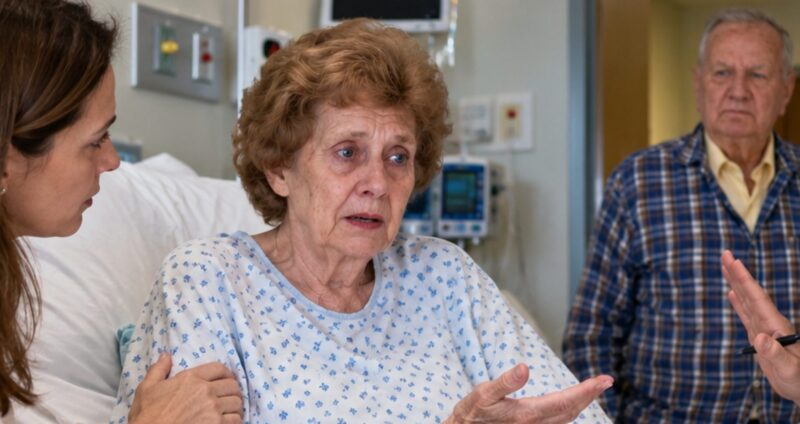
The doctor’s face changed.
“Did you want to eat bread?”
My mother paused.
“Many times.”
“And salt?”
“Yes.”
“And your husband wouldn’t allow it?”
My mother looked toward the door.
“No.”
A heavy silence filled the room.
The doctor stood up.
“Mr. Robert, could you wait outside for a few minutes, please?”
My father didn’t argue. He simply looked at my mother and then walked out.
I watched him leave, and suddenly old memories started coming back.
Christmas dinner fifteen years earlier.
My mother had reached for a piece of fresh bread.
My father had taken her gently but firmly by the wrist and said:
“No.”
I had even gotten angry with him.
Another time, at a restaurant, my father had asked the waiter to take my mother’s meal back because, according to him, “There’s too much salt in it.”
My mother had looked embarrassed.
At the time, I thought my father was simply being overprotective.
Now those same memories looked completely different.
The doctor continued asking questions.
“Did your husband ever punish you if you ate those foods?”
“Punish me? No.”
“Did he get angry?”
My mother gave a faint smile.
“Very.”
Something inside me turned cold.
“Mom, why didn’t you ever tell us?”
She looked at me.
“Because I didn’t want to.”
“For thirty years?”
“Yes.”
“Did Dad force you?”
My mother went silent again.
And somehow, that silence frightened me more than anything she could have said.
I walked out into the hallway.
My father was sitting in a chair with his hands resting on his knees.
“Dad.”
He looked up.
“Why did you forbid Mom from eating bread and salt for thirty years?”
He didn’t answer immediately.
“She told you?”
“Yes.”
“And she didn’t tell you anything else?”
My anger grew.
“What else was she supposed to tell me?”
My father slowly nodded.
“I see.”
His calmness made me even angrier.
“You’re not even going to defend yourself?”
He looked at me and said quietly:
“If Evelyn has decided not to tell the whole story yet, I’m not going to tell it for her.”
At that moment, the doctor opened the door.
“Mr. Robert, please come back in.”
We all entered the room.
My mother’s eyes were red.
The doctor had placed an old, thick medical folder on the table. My father had brought it with them to the hospital.
“These are your wife’s old medical records?”
“Yes,” my father said.
The doctor turned a few pages.
Then he looked at my mother.
“Mrs. Evelyn, I think it’s time to tell your daughter the part you left out.”
My mother stared at my father for a long moment.
Then she looked at me.
“Thirty years ago, I almost died.”
I froze. The continuation read in the comments 👇‼️👇‼️
My mother continued.
Back then, she had been feeling unwell for months. She had been hospitalized several times. For a long time, doctors couldn’t understand what was happening.
Eventually, they discovered that her body reacted very badly to certain foods, and because of another medical condition, her doctors had also placed her on a strict low-sodium diet.
They had given her a very specific eating plan under medical supervision.
But my mother had refused to follow it properly.
“I was stubborn,” she admitted. “After a few weeks of feeling better, I would convince myself that I was fine again.”
My father sat silently beside her.
“One night, I became so sick that Robert carried me to the car himself.”
I looked at my father.
My mother continued:
“After I came home from the hospital, I asked him to promise me something.”
“What?”
Her voice trembled.
“I told him, ‘If I start trying to convince you again that one little bite won’t hurt me, don’t listen to me. Even if I get angry. Even if I tell you I hate you in that moment, don’t let me do it.’”
I couldn’t speak.
My father finally said:
“After that, I became the bad guy in the family.”
But even that wasn’t the whole story.
For thirty years, my father had learned how to prepare meals that fit her medical needs.
Before they went to restaurants, he called ahead.
Before every family gathering, he spent hours in the kitchen making a separate version of the meal for her so she would never feel left out.
And they had hidden all of it from us.
“Why?” I whispered.
My mother smiled.
“Because I didn’t want you children to look at me like I was sick.”
The doctor closed the folder.
“I want to make one thing clear,” he said. “Restrictions like these should always be based on medical advice, not imposed by a spouse. But these records show that your father wasn’t inventing these rules. He was helping your mother follow the treatment plan her medical team had given her.”
My mother reached for my father’s hand.
“For thirty years, I’ve sometimes been angry with him.”
My father laughed softly.
“Sometimes is a very generous word.”
My mother laughed too.
Then she said:
“But I’m still here.”
Two weeks later, we celebrated their 58th wedding anniversary.
That evening, my father placed a small box in front of my mother.
She opened it.
Inside was a small specially prepared bread roll made according to a recipe approved for her by her doctor.
After her most recent tests, her specialist had told her she could safely try a small amount of that particular version.
My mother stared at it for a long time.
Then she looked at my father.
“Robert…”
He smiled.
“This time, I’m the one telling you it’s okay.”
My mother broke off a tiny piece, tasted it, and began to cry.
At first, I thought it was because of the bread.
But then she took my father’s hand and said:
“For thirty years, you kept a promise even on the days when I hated you for keeping it.”
My father shrugged.
“I promised I’d keep you beside me as long as I could.”
That night, I understood something I had completely missed at the hospital.
From the outside, their story could easily look like control.
But the truth was very different.
The most important part was this:
It had never been only my father’s decision.
Thirty years earlier, my mother had been the one who asked him that when she couldn’t tell herself “no,” he would be strong enough to say it for her.