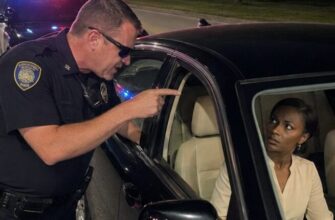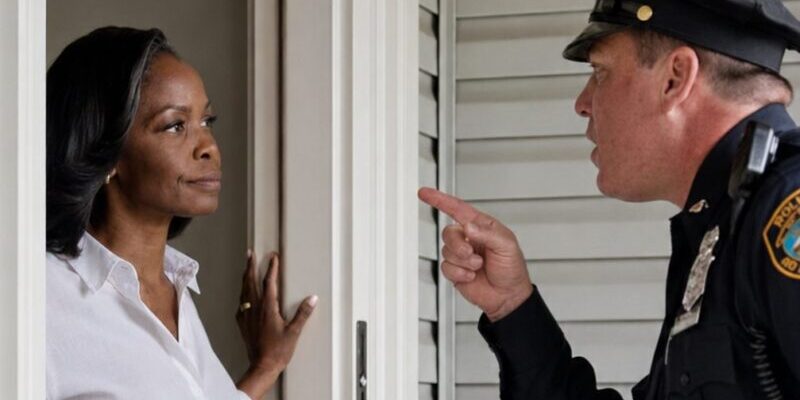
A police officer ordered a black woman to step out of Her own house—He had no idea who he was about to hand cuff 😱😨
“Step out of the house immediately and keep your hands where I can see them.”
Fifty-three-year-old Renee Caldwell stood frozen in the doorway of her own home, still wearing her gardening clothes, her
hair damp from a recent shower. The officer in front of her already had one hand resting on his handcuffs, while several
neighbors watched anxiously from their windows across the street.
“This is my house,” Renee said calmly.
Officer Kyle Briggs gave her a cold smile.
“That’s what you claim. Now you need to prove it.”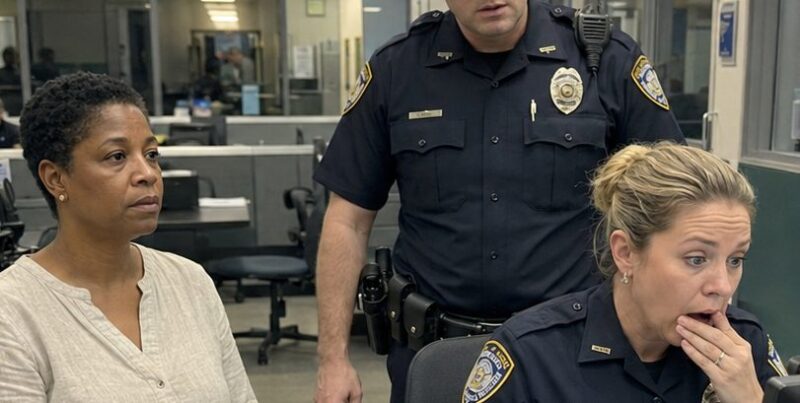
He had no idea that the camera above the front door was recording every word he said. He also had no idea who the woman
standing before him really was. Renee decided not to reveal that just yet.
That Saturday had begun like any other. Renee woke early, made coffee, read for a while, and then worked in the garden in
front of her house. She had purchased the property eighteen years earlier and had gradually renovated every room.
Around noon, she went inside and began preparing lunch when someone knocked forcefully on the door.
A uniformed officer stood on the porch. He introduced himself as Kyle Briggs and said they had received a call about a
suspicious person.
“Someone reported seeing an unfamiliar woman enter this house,” he said. “I need to verify your identity.”
Renee stared at him silently for a moment.
“Am I the ‘unfamiliar woman’?”
“Show me your identification.”
“Do you have a search warrant or reasonable suspicion that a crime has been committed?”
Briggs’s expression changed. He clearly had not expected her to question his demand.
“This is a welfare check. I don’t need a warrant.”
“A welfare check is a voluntary interaction. I have told you that I am safe and that I live here. Therefore, your welfare check is
complete.”
The officer moved forward, placing one foot on the first porch step.
“You’re being extremely defensive.”
“Because you’re forcing me to prove that I have the right to be inside my own home.”
“I don’t care about your story. I need proof.”
Renee did not raise her voice.
“Without a warrant, reasonable suspicion of a crime, or an emergency, you have no right to demand anything from me. That
is protected by the Fourth Amendment.”
Briggs stared at her for several seconds before pulling out his handcuffs.
“That’s enough. Turn around and put your hands behind your back.”
“On what charge?” What happened next read in the comments ‼️👇‼️👇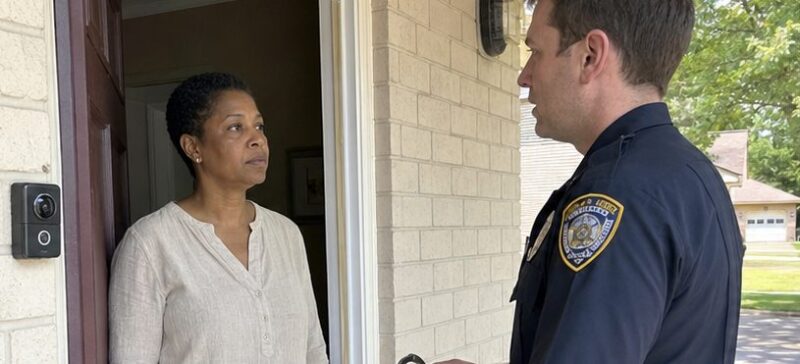
“Obstructing a police investigation.”
“But there is no investigation. You merely responded to a phone call.”
Renee knew that resisting would only make the situation worse. She slowly turned around and placed her hands behind her
back. The cold metal closed around her wrists. At that moment, she turned her head toward the doorbell camera and spoke
clearly.
“My name is Renee Caldwell. I am being arrested outside my own home at approximately 12:45 p.m. I am not resisting, but I
am stating for the record that this arrest is unlawful. The camera is recording everything.”
Her neighbor Gloria came running from across the street.
“Renee, what’s happening?”
“Call James Whitfield. Tell him to preserve the camera footage immediately.”
Briggs placed Renee in the back seat of his patrol car. During the drive to the station, she neither cried nor argued. Instead,
she memorized every word, every time, and the precise order of the officer’s actions.
At the station, Sergeant Ivonne Harris examined the arrest report. She read the charge and then checked the property
address on her computer. The owner’s name appeared immediately: Renee M. Caldwell.
“You arrested the homeowner outside her own house?” Harris asked in disbelief.
“She refused to provide identification and obstructed the investigation,” Briggs replied.
“What investigation? Did you have any evidence that a crime had been committed?”
Briggs had no answer. Several minutes later, the watch commander entered and ordered the handcuffs to be removed
immediately.
“Ms. Caldwell, you are free to leave. We sincerely apologize.”
Renee slowly rubbed the red marks on her wrists.
“First, I want the arrest report, the original call recording, the officer’s body-camera footage, and his written statement.”
The commander looked confused.
“Why do you need all those documents?”
For the first time, Renee revealed the truth.
“Because I am a professor of constitutional law at the University of Memphis School of Law. For twenty-one years, I have taught future attorneys what constitutes an unlawful arrest.”
The room fell completely silent. The color drained from Briggs’s face.
On Monday morning, Renee filed a civil rights lawsuit. The footage from her doorbell camera was released to the public and received millions of views within days. It proved that Renee had remained calm, had not resisted, and had committed no crime.
The internal investigation uncovered something even more disturbing. During the previous three years, forty-one homeowners had been detained after similar calls while standing inside or outside their own homes. Thirty-six of them were Black.
Kyle Briggs was fired, and the city was forced to pay Renee $5.2 million and completely reform its police welfare-check procedures.
Renee donated most of the money to provide legal representation for people who had no cameras, attorneys, or resources to fight back.
Months later, she stood on the same porch and said:
“The camera and my knowledge of the law saved me. But this fight was never only about me. It was for the next person who might one day be forced to prove that they have the right to stand on the doorstep of their own home.”