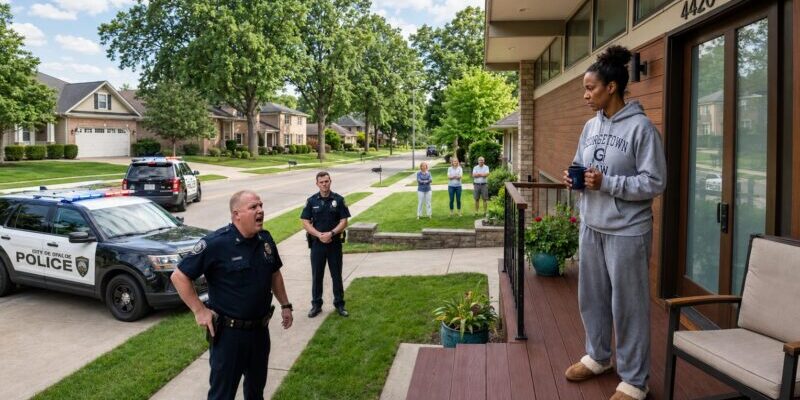
The police officer stood in front of my house and shouted, “Hands up! You don’t belong in this neighborhood.” He had no
idea who he was actually talking to 😱‼️
That morning, I was simply standing on the porch of my own home with a cup of coffee in my hand.
I was wearing a gray tracksuit, my hair was tied in a bun, and I was enjoying the rare silence that followed a long and
exhausting week at work. Suddenly, a police car stopped in the street.
The door flew open, and a heavyset, middle-aged police officer stepped out. A younger officer climbed out behind him.
The first officer marched aggressively toward my porch steps.
“Hands up! Right now!” he shouted.
I froze. My coffee cup nearly slipped from my hand.
“What is happening?”
“Put the cup down and show me your hands.”
I slowly placed the cup on the railing and raised both hands. That was when I noticed several of my neighbors coming out of
their houses. They stood on the sidewalk and watched us. Some of them were recording with their phones.
“This is my private property,” I said calmly. “I live here.”
The officer climbed onto the first step and looked at me with contempt.
“We received a report about a suspicious person.”
“And what exactly makes me suspicious?”
He remained silent for a moment before saying the sentence that changed everything.
“You don’t belong in this neighborhood.”
I felt a heavy knot form in my throat.
I had purchased that house six months earlier. I had worked for fifteen years to afford it. I had held two jobs, studied at night,
and gone almost entirely without vacations for years.
But to that man, I was merely a Black woman who, in his mind, could not possibly own a home in a neighborhood like this
one.
“Who called you?” I asked.
The officer did not answer. Instead, he demanded to see my identification.
“My identification is inside the house.”
“Convenient answer.”
The younger officer looked at him nervously.
“Maybe we should verify the address and the homeowner’s information first,” he whispered.
“I know what I’m doing,” the older officer snapped.
I continued staring at them with my hands raised. I was afraid to make any sudden movement, but at the same time, anger
was building inside me. Then my neighbor, Mrs. Patterson, approached from across the street.
“Officer, she lives here,” the woman said. “I watched her move in.”
The officer did not even look at her.
“Ma’am, stay back.” What happened next read in the comments 👇‼️👇‼️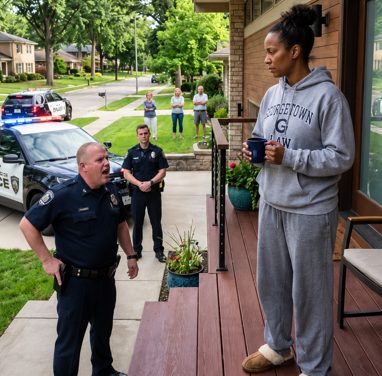
At that moment, I heard a signal from the camera attached to the younger officer’s uniform. I realized everything was being
recorded. And that was what helped me remain calm.
“I am going to slowly lower my right hand and take my phone out of my pocket,” I said clearly. “I want to call my attorney.”
“No calls!” the officer shouted.
“Am I under arrest?”
He said nothing.
“If I’m not under arrest, then you cannot stop me from making a phone call.”
His face turned red. He climbed another step, but the younger officer grabbed his arm.
“Sir, dispatch has confirmed it. The house is registered in her name.”
The entire street fell silent. The officer looked at me, but he did not apologize.
“There has been a misunderstanding,” he muttered. “You can lower your hands.”
“And what about the part where you said I didn’t belong in this neighborhood?”
He turned around and walked away. Before getting back into his police car, he looked at the gathered neighbors and said:
“The show is over. Everyone go back inside.”
He believed it was finished. But it was only beginning. I was a former prosecutor.
For years, I had handled cases involving abuse of official authority. Six months earlier, I had left my position and opened a
legal organization that helped people who had suffered from unlawful police conduct.
The officer had no idea.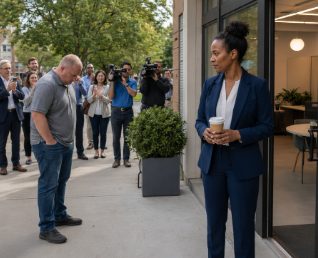
That same day, I collected the videos recorded by three of my neighbors. Then I submitted a formal request to the police
department, demanding the complete body-camera footage from both officers, as well as their conversations with dispatch.
It turned out that no one had reported a burglary at my house. The caller was the man who lived across the street, Mr.
Collins. He had told the dispatcher:
“There’s an unfamiliar Black woman on our street. She’s standing on the porch. Please send someone to check.”
The dispatcher had asked if the woman was attempting to break into the house. Collins had replied:
“No. I just don’t think she belongs here.”
But the most disturbing discovery came afterward.
The officer who had shouted at me already had seven similar complaints filed against him. Four of them had come from
Black residents. Two complaints had disappeared from the system, while the others had been closed due to a supposed
“lack of evidence.”
This time, there was evidence. Three videos. Two body-camera recordings. Twelve witnesses. And me.
I did not immediately publish the video online. I did not want to create outrage that would disappear after a few days. I
wanted him to be held accountable for his actions.
I filed a formal complaint, a civil lawsuit, and a demand for a complete investigation into the officer’s previous conduct.
One week later, he was suspended from duty.
One month later, an internal investigation was opened against him.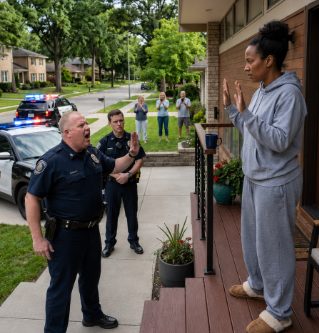
During the investigation, officials discovered that he had not only concealed previous complaints but had also pressured
younger officers to change their reports.
He was fired, stripped of several pension benefits, and permanently banned from serving in any law-enforcement agency.
Mr. Collins, the neighbor who had called the police, later tried to apologize. He arrived at my house carrying flowers. I did not
go outside.
Instead, my attorney handed him a copy of the discrimination lawsuit filed against him.
Several months later, the city agreed to pay a settlement. But I did not keep the money.
I used it to open a free legal-support center right in our neighborhood. On the building’s glass door, I placed a message in
large letters:
“Everyone belongs in the place they legally call home.”
The younger officer who had tried to stop his partner attended the opening. He apologized for not intervening sooner.
I accepted his apology.
The former officer stood on the opposite side of the street. He watched the building, the reporters, and the people he had once intimidated.
Our eyes met.
I smiled, lifted my coffee cup, and stood calmly on the porch of my own home.
This time, he was the one who had to lower his eyes.