My father told everyone I was a nurse because he was ashamed to admit his daughter was a soldier… But the day the
entire town gathered outside our house, he learned what I had done 😱💔
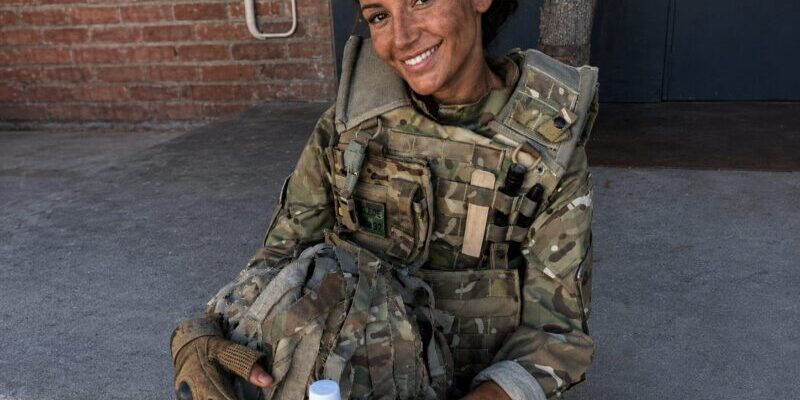
The first time my father saw me standing on our front porch in military uniform, he stared at me for several seconds, then
quickly closed the door so the neighbors wouldn’t notice.
“Come inside and change immediately,” he said. “Women in our family don’t wear clothes like that.”
At that moment, I realized that even after years of service, I still wasn’t the daughter he could be proud of.
My name is Emily Carter. I grew up in a small American town where everyone knew everything about one another. My father,
Robert, owned a small auto repair shop. He was strict, hardworking, and deeply old-fashioned.
Ever since I was little, I had heard the same remarks.
“If I had a son, I would leave the repair shop to him.”
“A girl should find a good husband instead of doing men’s work.”
“A woman should take care of the family, while a man protects the country.”
I loved my father, and for years I tried to prove that a daughter could also be the child he had always wanted. After school, I
helped at the repair shop, changed tires, and knew the names of tools better than most boys in my class. But my father
never said he was proud of me.
When I turned twenty and told him I was joining the military, he refused to speak to me for two days.
My mother quietly packed my suitcase while my father sat at the kitchen table, staring out the window. Before leaving, I
approached him, hoping he would at least hug me.
He only said, “When you realize you’ve made a mistake, come home. But don’t walk into my repair shop wearing that
uniform.”
I left while fighting back tears.
The first months of service were difficult. Many times, I wanted to call my father father and tell him I couldn’t take it anymore.
But each time, I remembered the certainty on his face and forced myself to continue.
Over the years, I learned not only to endure hardship, but also to become someone others could depend on. I received
emergency medical training and joined a military unit that evacuated civilians during disasters.
My mother secretly told me that my father had been telling everyone in town I worked as a nurse in another state.
He had even removed my photographs from the living-room wall so no one would see me in uniform. It hurt, but eventually,
I stopped asking for his approval.
Then came the night when our unit was urgently deployed to a small town where days of heavy rain had caused the river to
overflow.
The water was rising by the hour. Houses were being evacuated, and roads were disappearing beneath the flood. At around
two in the morning, we learned that twenty-three children and three teachers were trapped inside an elementary school.
They had been returning from an event outside town when the flood blocked their route, forcing them to take shelter in the
school building. The water had already reached the windows of the first floor.
Rescue vehicles couldn’t get close enough. The powerful current swept away everything in its path, while the children stood
at the second-floor windows, flashing lights to signal for help.
Our unit commander decided we should wait until sunrise because entering the building in the darkness was extremely
dangerous. But the latest weather reports showed that one of the school’s aging walls could collapse before morning.
I suggested using metal cables from a nearby warehouse along with our rescue harnesses. We could create a secure line
between two buildings and bring the children out one at a time. Someone had to cross the rushing water first. I volunteered.
The freezing water rose to my chest. The current knocked me off my feet several times, but I clung to the cable and
eventually reached a school window.
Inside, the children were crying. One of the teachers was holding the youngest girl, who could not walk without crutches.
She was the first child I secured in a rescue harness.
Over the next two hours, we brought out all twenty-three children and their teachers. Moments after I made sure no one
remained inside, part of the school collapsed into the floodwater.
I injured my shoulder and spent several days in the hospital, but not a single child lost their life.
I was instructed not to share any details until the official investigation was completed, so I only told my family that I had
suffered a minor injury.
My father didn’t even call. My mother said he was angry because he believed I had once again put myself in “pointless
danger.” Two months later, I received leave and returned home. That was the day my father saw me on the porch and
demanded that I change out of my uniform.
“I told the neighbors you were a nurse,” he whispered. “Don’t embarrass me.” The continuation read in the comments ‼️👇
⏩‼️👇
I said nothing. I picked up my suitcase and was about to leave when I heard the sound of a bus at the end of the street.
A yellow school bus stopped in front of our house.
Its doors opened, and children stepped out accompanied by their parents and teachers. Some carried flowers, while others
held handmade cards.
The little girl I had carried out of the school approached me on her crutches. She wrapped her arms around my legs and said
loudly:
“Daddy, this is the soldier who carried me through the water.”
Her father was the mayor of our town.
He approached my father, shook his hand, and said, “Your daughter saved my child and twenty-two others. If she hadn’t entered that building, none of them would have survived until morning.”
Then fire trucks and police vehicles arrived outside our house. In front of everyone, my commander read an official commendation and presented me with a medal for bravery.
But then something else was revealed.
The families of the rescued children had raised money to reward me. I had refused to accept it and donated the entire amount—more than $80,000—to rebuild the school and install a new emergency evacuation system for children with disabilities.
When my commander announced it, my father lowered his head.
I had never seen him so silent.
He slowly approached me, placed his hands on my shoulders, and, for the first time, spoke in front of everyone.
“I spent my whole life complaining that I didn’t have a son. But God gave me a daughter who returned twenty-three children to their families. You were never the one I should have been ashamed of, Emily. I was.”
Later, he personally hung my photograph on the most visible wall of his repair shop.
Beneath it, he wrote one sentence:
“My daughter, Soldier Emily Carter—the greatest pride of my life.”