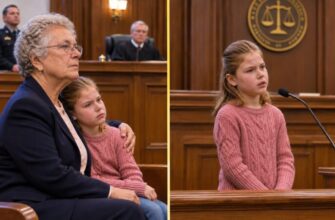
My 64-year-old father had a stroke… and my sister said, “No one forced you to care for him” 😢💔
My father, Fernando, was always the kind of man who couldn’t say
“I love you.”
He said those words in other ways.
When I was little, he bought me the most beautiful shoes, even when his own jacket was already worn out and he had only
bus fare left in his wallet. He used to say:
“A girl with good shoes goes further in life.”
It took me years to understand that he wasn’t really talking about shoes.
When I was fifteen, he organized a small gathering at our house for my friends. He spent the whole day in the kitchen,
pouring tea, making sandwiches, smiling at everyone. My friends would say:
“Your father is so kind.”
And I was at that age when children often don’t appreciate their parents. I only shrugged.
When I went to Zaragoza to study, he called me every Sunday. Whether it rained, whether he was sick, whether he was tired
— he called. He asked if I had eaten, if I was dressed warmly, if I needed money. He never talked for long, but there was home
in his voice.
And when my nine-year relationship with Daniel ended, I returned to my father with empty eyes and a heavy heart. He asked
nothing. He didn’t say, “I warned you.” He didn’t say, “Why did it take you so long to understand?” He simply made his
famous chicken rice, placed it in front of me, and said:
“Eat. We’ll think later.”
My grandfather, the man who had never seemed afraid of anything, was lying under white sheets, one arm connected to an
IV. When he opened his eyes and saw me, he tried to smile. That smile broke me.
The doctor said his left leg was no longer responding. Recovery would be long. He would need help with everything —
bathing, dressing, walking, sometimes even reaching the bathroom on time.
I could have hired someone. I could have moved him into a good care center. That would not have been a bad decision.
Many people do that, and I would never judge them. But when I looked at my father, I thought about the shoes. About the
Sunday phone calls. About the chicken rice. mind I couldn’t leave.
I spoke to my manager, took time away from work, sublet my apartment in Zaragoza to a student, packed two suitcases, and
returned to my childhood home.
My room was almost the same. The stain on the ceiling was still there. When I was little, I used to say it looked like a rabbit.
My father had promised for years to repaint the ceiling, but he never did, because I wouldn’t let him.
“My rabbit will disappear,” I used to say.
And he would laugh. Four months later, my life had become as precise as a clock.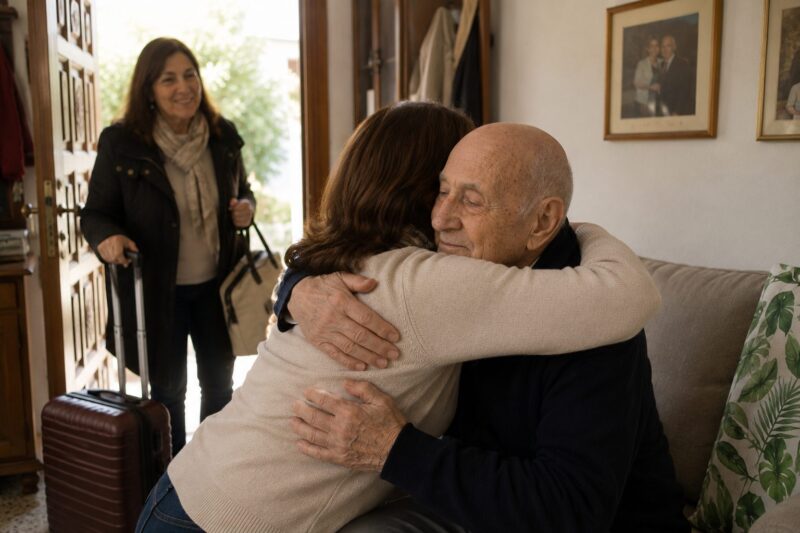
At seven in the morning — medicine. Then breakfast. Then bathing. Sometimes he felt ashamed, closed his eyes, and said:
“Daughter, this is not your job.”
I smiled, even though I was breaking inside.
“You washed my hair when I was little too.”
And he would fall silent. Three times a week, the physical therapist came — Marta. She was a patient woman and always
said:
“Step by step. A little today, more tomorrow.”
In the evenings, we watched documentaries about animals. My father loved lions. He said they were strong in silence.
Sometimes I looked at him and thought he had been like that his whole life. But I was tired.
My sister, Patricia, lived in Bilbao. She had her children, her job, her home. I understood that. But she only called on Sundays,
for ten minutes. Always at the same time. Sometimes I even felt she was calling out of duty, not longing. One Sunday, I said:
“Dad had a bad night. I barely slept.”
She was silent for a moment, then said:
“Laura, you’re sacrificing too much. There are good care centers. He would be safe there, and you could get your life back.”
I stayed quiet.
“It’s your choice,” she added.
“No one forced you.”
Those words hit me like a slap. What happened next read in the comments ‼️👇‼️👇
That night, I locked myself in the bathroom and cried. Not just a few tears. I cried so hard my hands were shaking. For the
first time, one thought crossed my mind:
“Maybe I can’t do this anymore.”
And I was most ashamed of that thought.
The next days passed in silence. Patricia didn’t call. I didn’t write either. My father could feel that something was wrong, but
he didn’t ask questions. Only one evening, while we were watching our documentary, he placed his hand over mine.
He said nothing. But I understood that he understood.
Two weeks later, it was a rainy morning. I was in the kitchen making coffee. My father was still in his room. Outside, the rain
tapped against the window, and the house was quiet. Suddenly, the doorbell rang. I opened the door… and froze.
It was Patricia. In one hand, she held a suitcase. In the other, bags of groceries. Her hair was wet from the rain, her eyes red.
She looked at me, then looked down, as if she didn’t know what to say. I didn’t know either. For a few seconds, we both stood
in silence. Then she said softly:
“I don’t know how to do all of this, Laura.”
My throat tightened.
“But I realized I left you alone,” she continued. “And that wasn’t fair.”
I wanted to say, “It’s too late.” I wanted to say, “You didn’t understand.” I wanted to hurt her as much as her words had hurt
me. But at that moment, we heard the sound of the walker from the hallway.
My father slowly came out of the room. Every step was difficult. But he stopped in the middle of the hallway and looked at
us.
Patricia’s face changed. Her eyes filled with tears. Maybe for the first time, she saw our father not through a phone call, but in
real life — weak, aged, yet still the same Fernando. She placed the grocery bags on the floor, walked to him, and knelt in front
of him.
“Dad…” she whispered.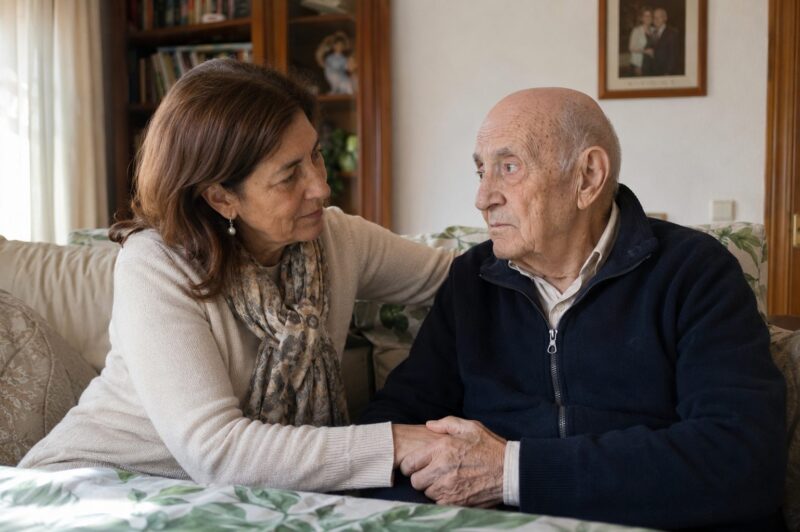
With a trembling hand, my father stroked her hair. Patricia began to cry.
“Forgive me. I was afraid to see you like this. I was afraid I wouldn’t know how to help. And instead, I pretended I was busy.”
I stood by the door, unable to move. Then Patricia turned to me.
“This week, I’m the one getting up at seven,” she said.
“You’re going to sleep.”
That simple sentence made me fall apart. Not from pain, but from relief.
That day, the three of us had breakfast in the same kitchen. Patricia cut the bread wrong, mixed up the medication schedule,
and didn’t know where the towels were. But she was there.
And that evening, when my father managed to take four steps with his walker, we were both standing on either side of him.
He stopped, looked at us, and smiled.
That smile was the same one he had years ago, when he taught me to ride a bicycle and secretly let go of the seat.
Back then, I didn’t fall. And that day, I didn’t fall either. Because finally, I was no longer alone.